
The puzzle library
Find your next kind of puzzle.
Explore 74 pencil-and-paper puzzle types. Open any entry for its goal and complete rules, or filter the library by name and style.
74 puzzle types
SkyscrapersFill the N×N grid with building heights 1 through N so each height appears exactly once in every row and column. A clue outside the grid tells how many buildings are visible when looking from that side. Taller buildings hide shorter buildings behind them.
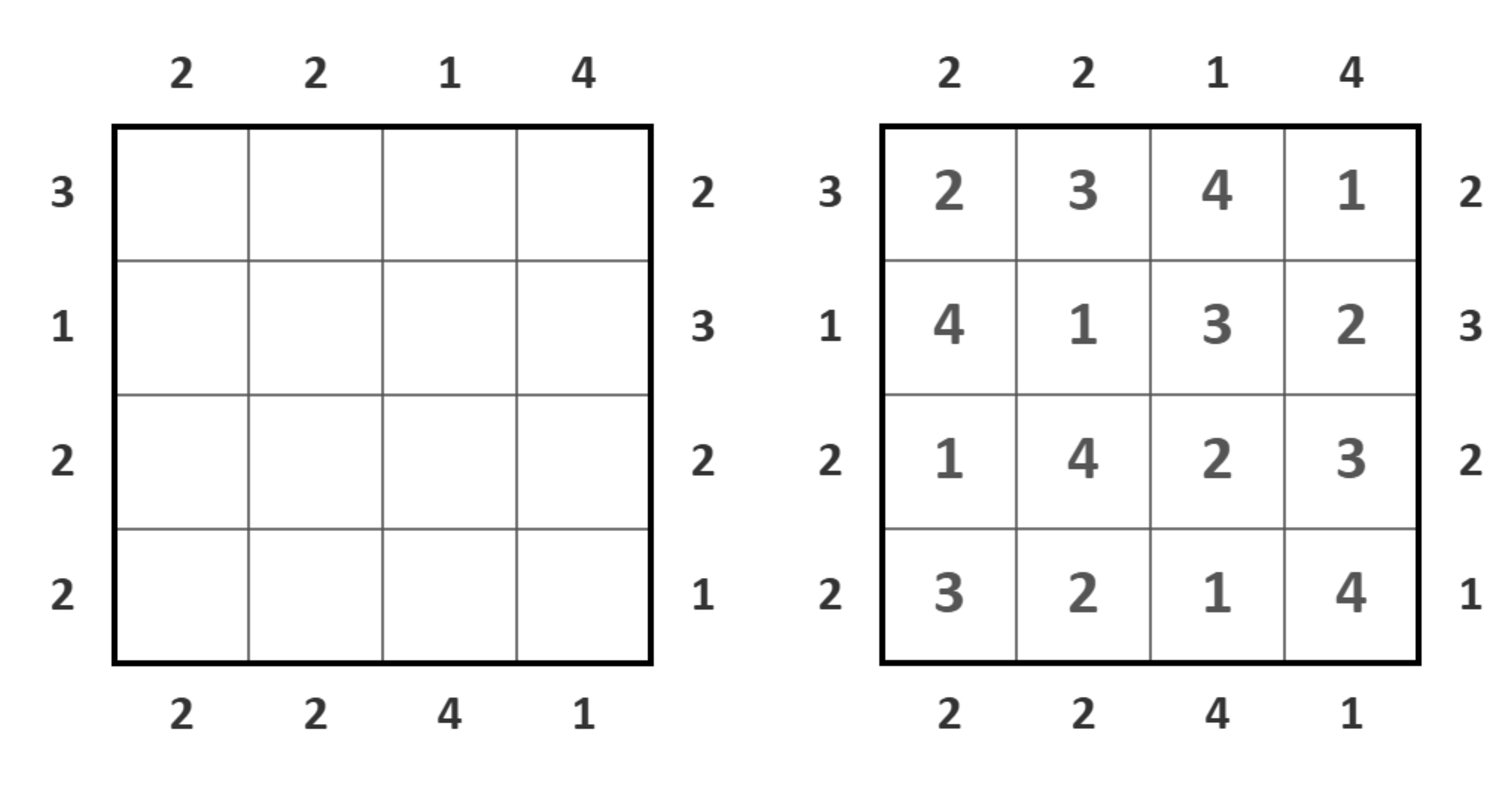
Goal: Fill the grid with building heights 1 through N. Rules: - Each row and column must contain every height from 1 to N exactly once. - Each outside clue shows how many buildings are visible from that direction. - A building is visible only if every building before it is shorter; taller buildings hide shorter buildings behind them.
- Logic
- Grid
- Placement
The SightlineShade cells black so every numbered cell sees exactly its stated number of white cells horizontally and vertically, including itself. Numbered cells must remain white. Black cells cannot share an edge, and all white cells must stay connected.
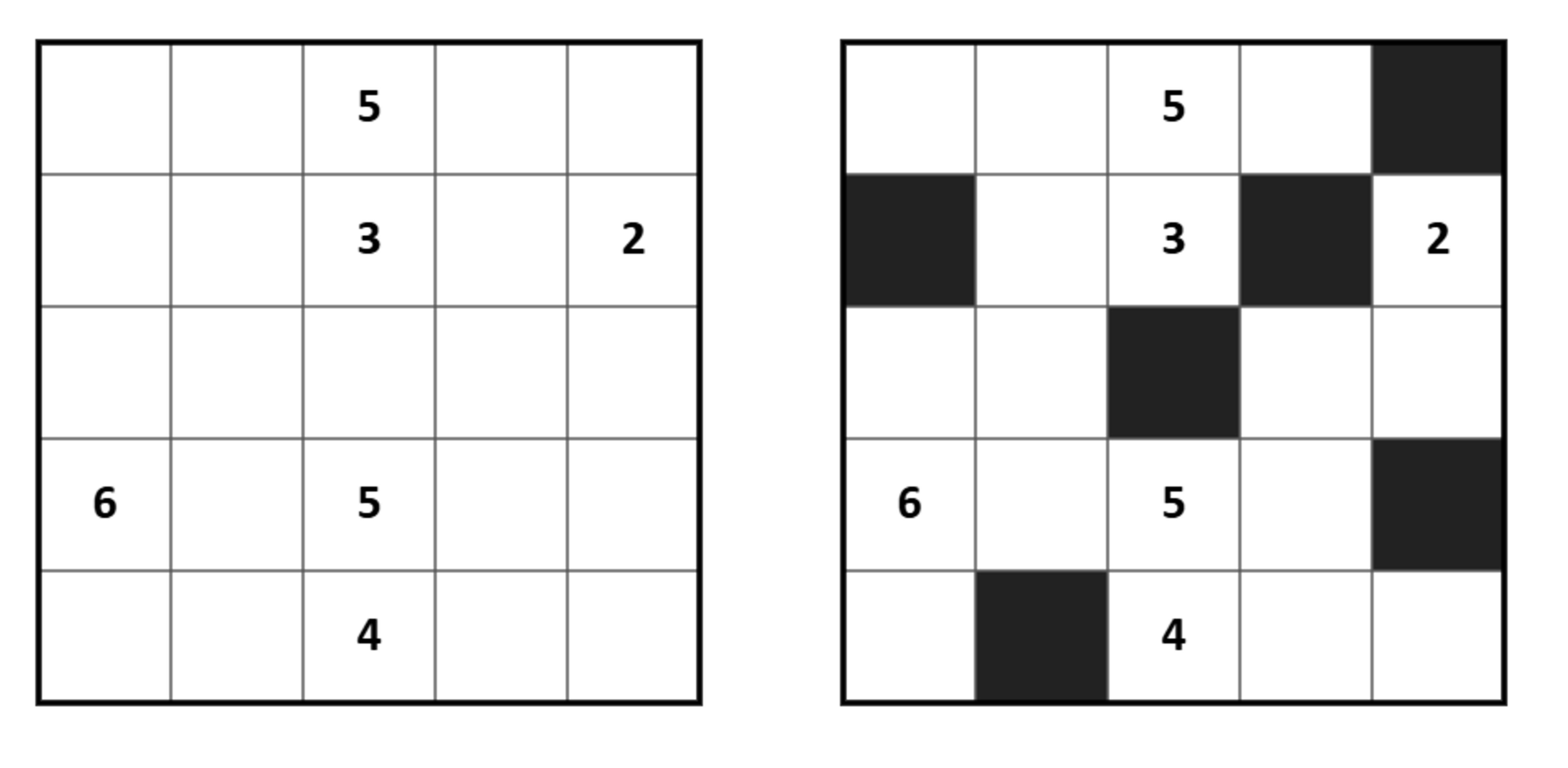
Goal: Shade cells black so every numbered clue has the correct sightline total. Rules: - Numbered cells must remain white. - A clue counts its own cell plus all consecutive white cells visible horizontally and vertically until the grid edge or a black cell is reached. - Black cells cannot share an edge. - All white cells must form one orthogonally connected area.
- Logic
- Grid
- Shading
NumberlinkConnect each pair of matching numbers with one continuous path. Paths move horizontally or vertically and cannot cross, overlap, branch, or pass through another numbered cell. Every grid cell must belong to exactly one path.
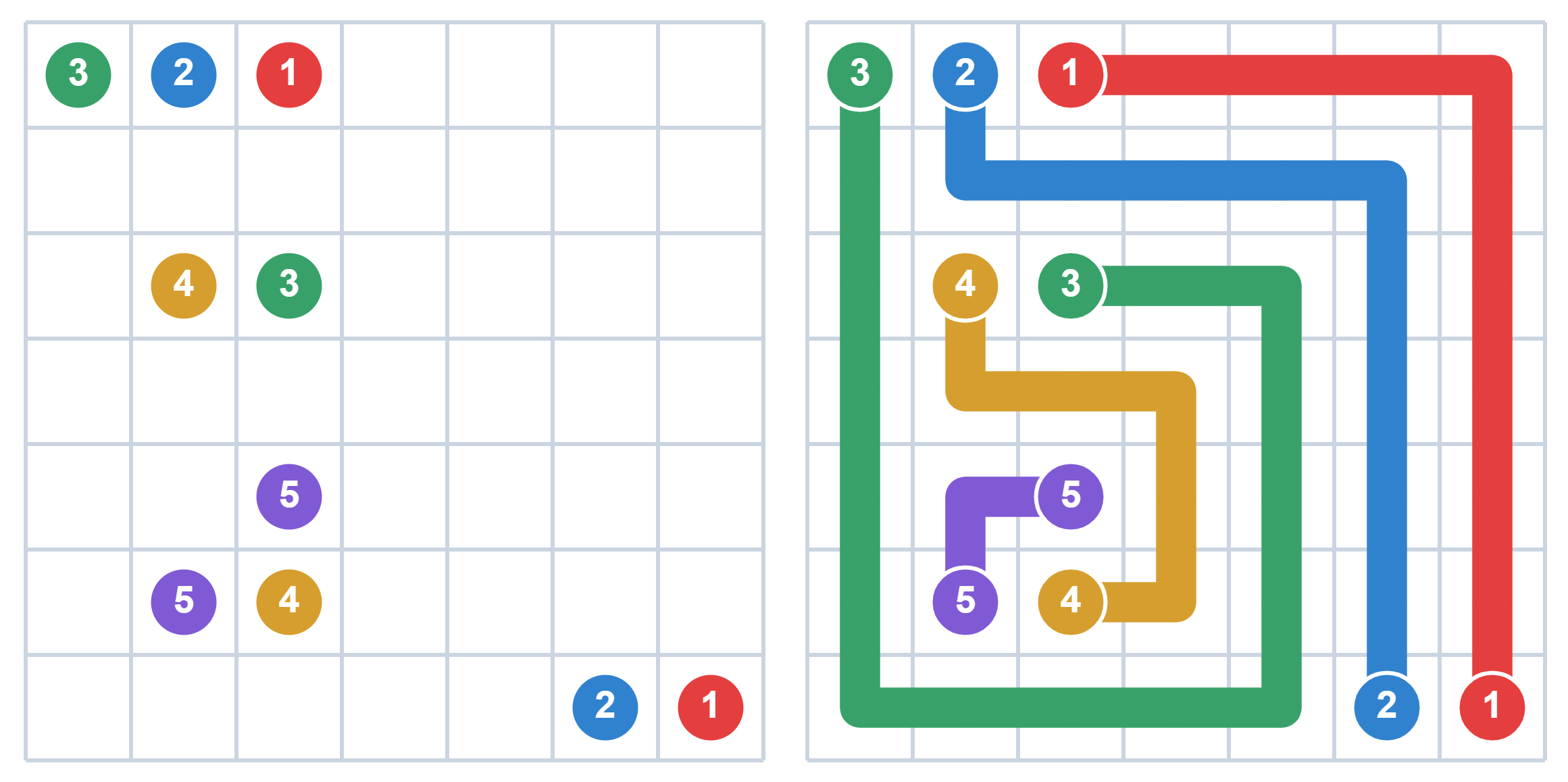
Goal: Connect every pair of matching numbers. Rules: - Each pair is joined by one continuous path that moves horizontally or vertically. - Paths cannot cross, overlap, branch, or pass through a number belonging to another pair. - Every cell, including the numbered endpoints, must be used by exactly one path.
- Logic
- Path
- Grid
Football TacticsDraw one passing route from the left goal to the right goal that visits every player dot exactly once. Use straight, non-crossing segments. Continue straight through white players, turn 90° at black players, and obey any numbered visit-order clues.
Goal: Reconstruct one passing route from the left goal to the right goal. Rules: - The route must visit all 24 player dots exactly once. - Join aligned players with straight segments; segments cannot cross or overlap. - The route must continue straight through every white player. - The route must make a 90° turn at every black player. - Numbered players must be visited in the exact order shown, beginning with 1 after the starting goal.
- Path
- Logic
- Grid
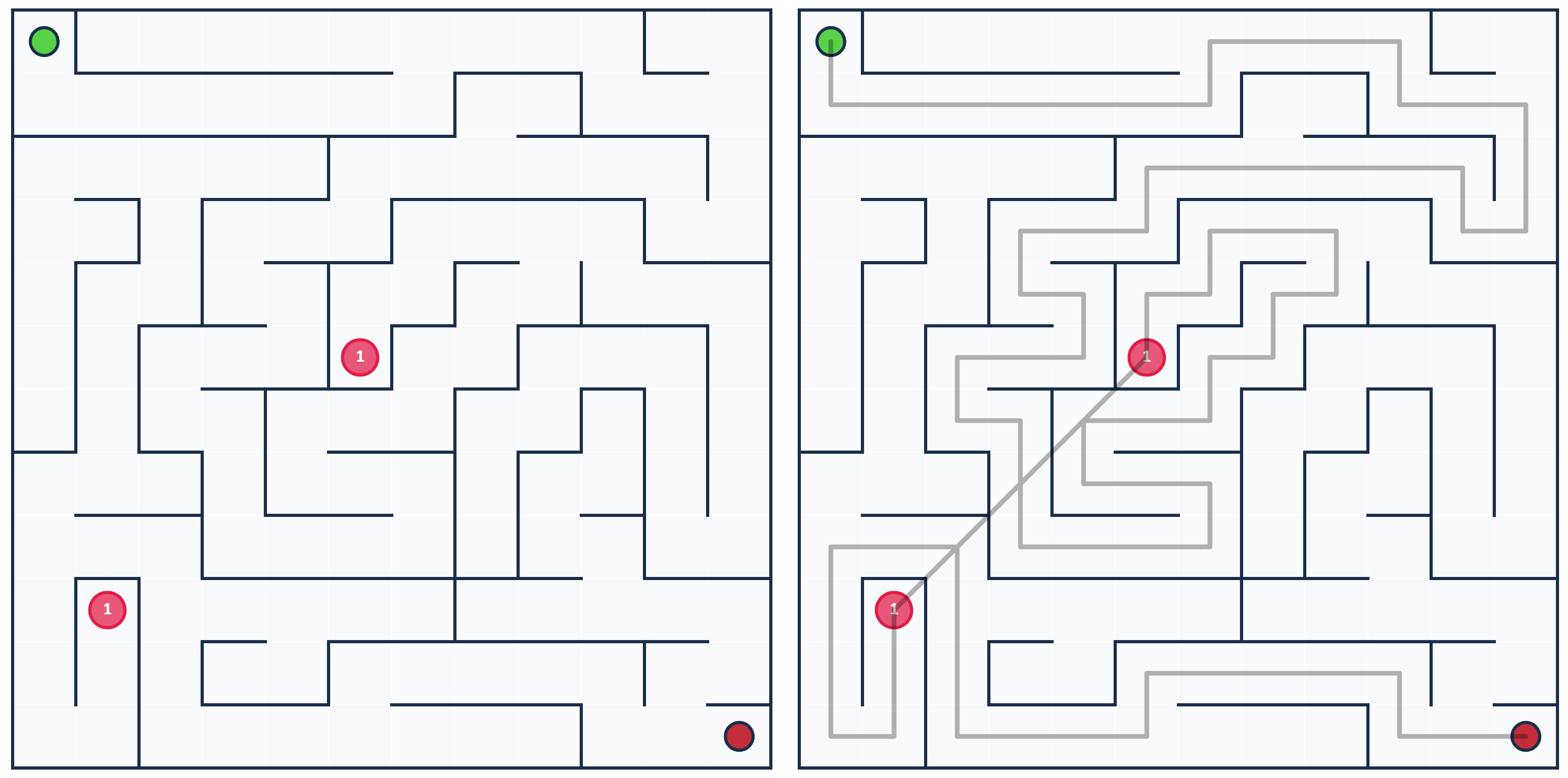
The Waypoint PathDraw one path from the green 1 to the orange 1. Move to horizontally, vertically, or diagonally adjacent cells while following the repeating sequence 1–2–3–4. Visit every cell exactly once without revisiting or crossing the path.
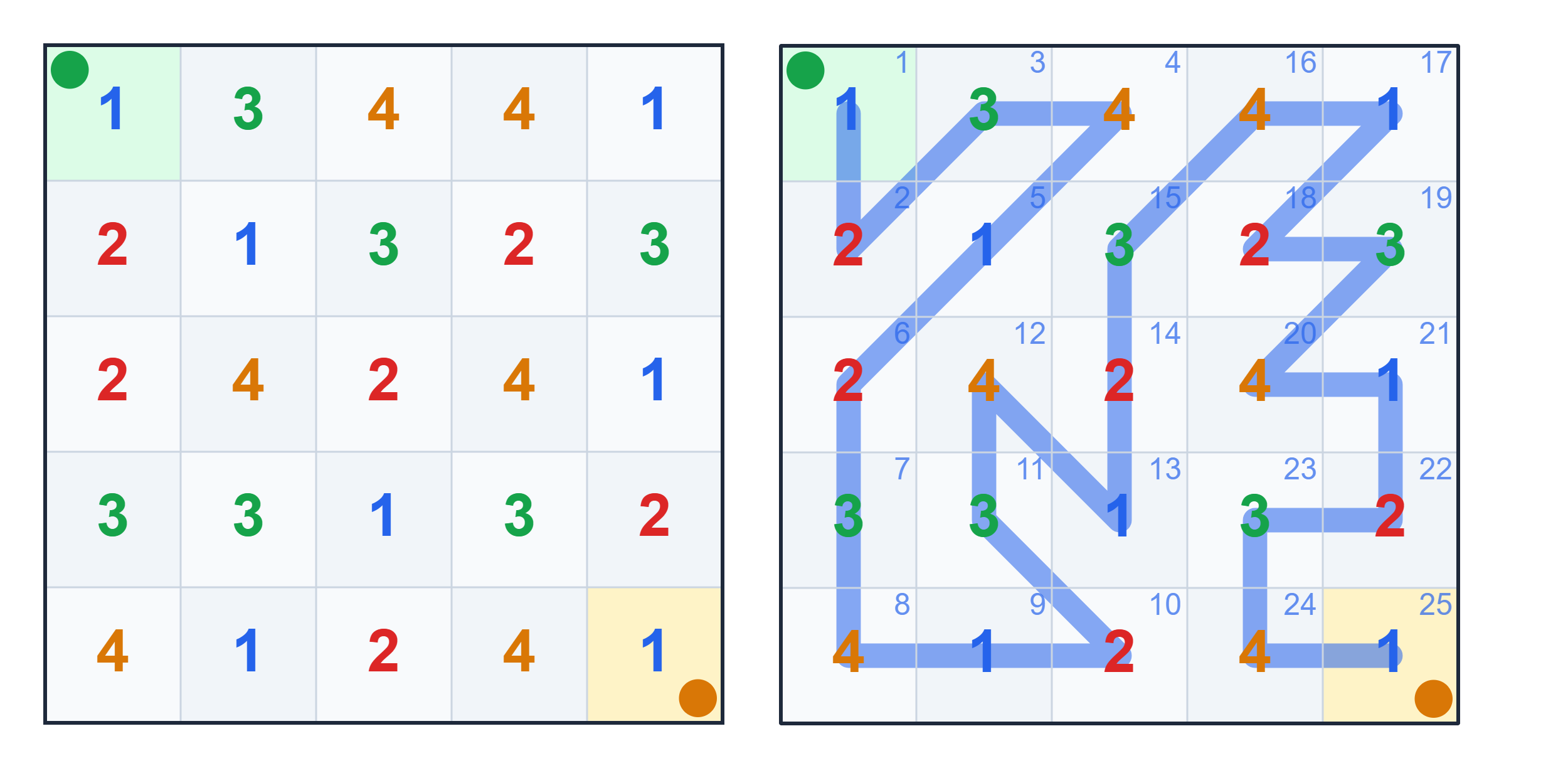
Goal: Draw one continuous path from the green 1 to the orange 1. Rules: - Consecutive cells must follow the repeating sequence 1–2–3–4. - Each move may be horizontal, vertical, or diagonal to an adjacent cell. - Every cell must be visited exactly once. - The path cannot revisit a cell or cross itself.
- Logic
- Path
- Grid
Sudoku RepairRepair the incorrect 9×9 Sudoku. First solve the outside Nonogram clues to identify the shaded cells; those cells contain the incorrect entries. Replace only those entries so the completed grid follows standard Sudoku rules.
Goal: Identify and correct the wrong entries in the Sudoku grid. Rules: - Use the row and column Nonogram clues to determine which cells must be shaded. - Every shaded cell marks an incorrect Sudoku entry; unshaded entries remain fixed. - Replace the incorrect entries so each row, column, and 3×3 box contains the numbers 1–9 exactly once.
- Sudoku
- Nonogram
- Logic
- Grid
The Four ClearingsComplete the 9×9 Sudoku. Each row, column, and standard 3×3 box must contain 1–9 exactly once. Each additional shaded 3×3 window must also contain 1–9 exactly once.
Goal: Complete the Windoku grid. Rules: - Each row, column, and standard 3×3 box must contain the numbers 1–9 exactly once. - Each shaded 3×3 window must also contain the numbers 1–9 exactly once. - All standard and shaded-region rules apply at the same time.
- Sudoku
- Variant
- Logic
- Grid
MagnetsFill each outlined 1×2 area with a magnet or leave it blank. A magnet contains one + pole and one − pole. Edge clues give the exact number of each pole in every row and column, and matching poles cannot touch horizontally or vertically.
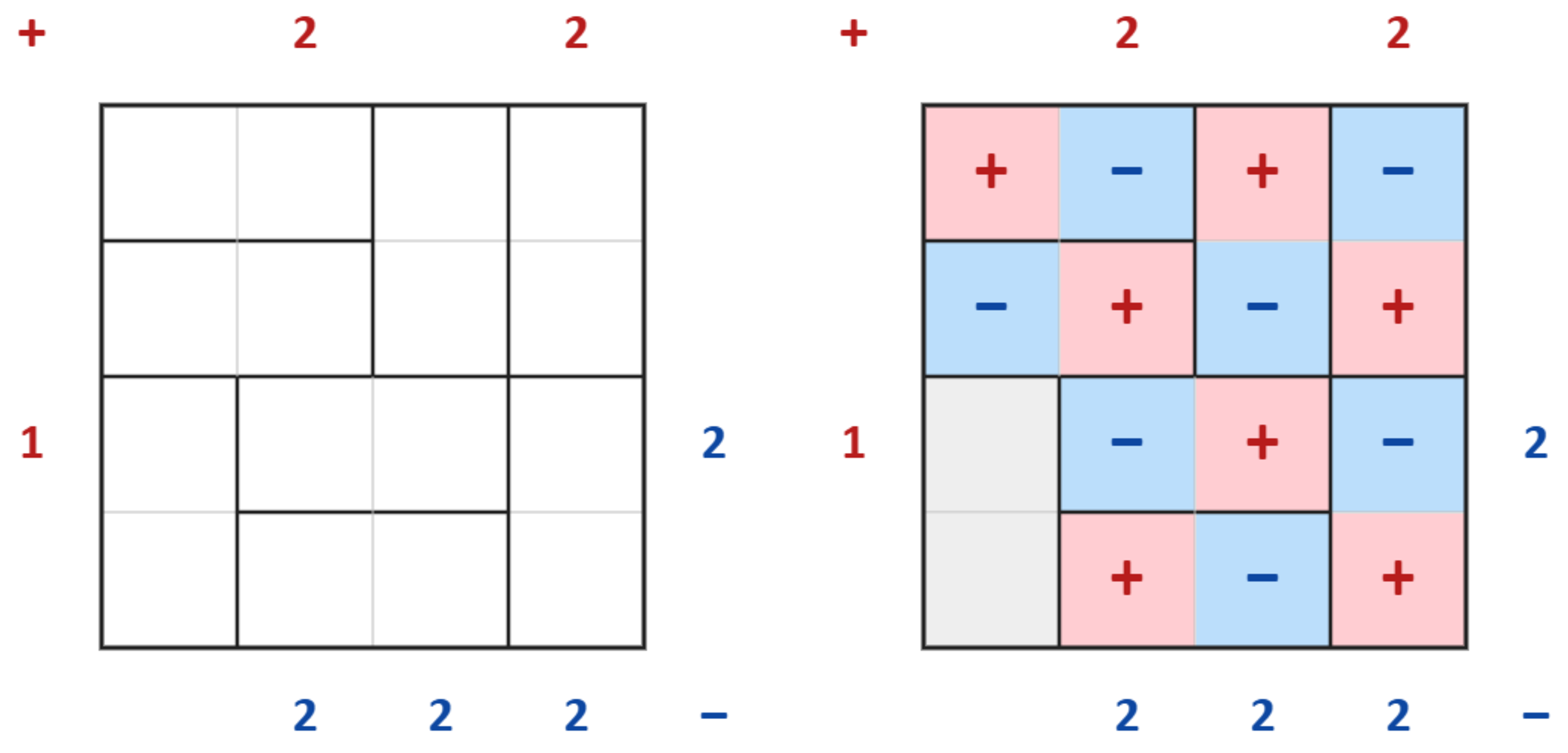
Goal: Decide which outlined 1×2 areas contain magnets and orient each magnet correctly. Rules: - Each outlined pair is either blank or contains one + pole and one − pole. - Edge clues show the exact number of + and − poles in each row and column. - Two + poles cannot share an edge, and two − poles cannot share an edge. - Blank pairs contain neither pole.
- Numbers
- Logic
- Grid
- Placement
Bridges (Hashiwokakero)Connect all islands into one network with horizontal or vertical bridges. An island’s number gives its total number of bridges. Connect only the nearest visible island in a direction, use at most two bridges between a pair, and never cross bridges.
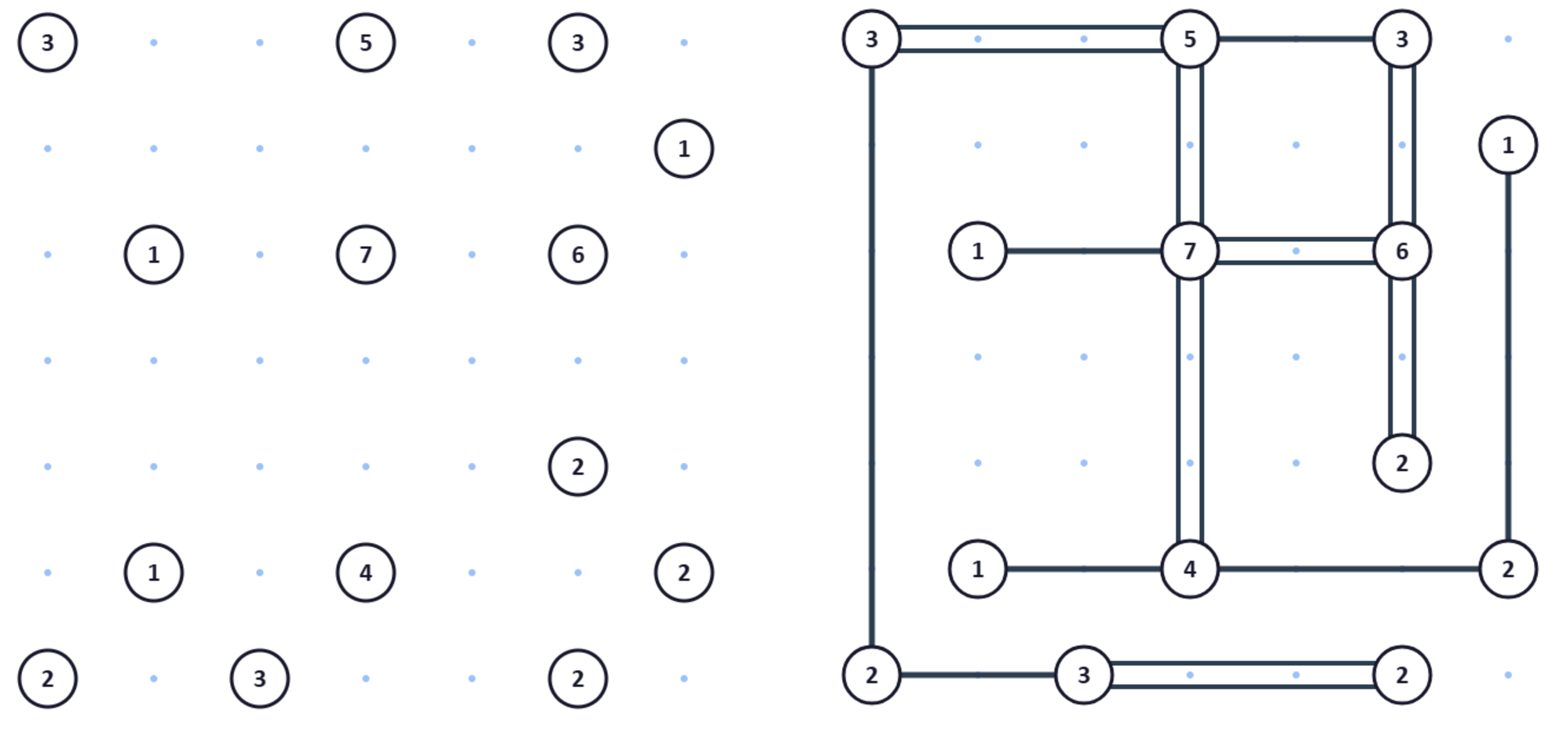
Goal: Connect all islands into one continuous network. Rules: - Bridges run only horizontally or vertically between islands in the same row or column. - A bridge may connect only the nearest visible island in that direction and cannot pass through another island. - Each island number gives the exact total number of bridges attached to it. - At most two bridges may connect the same pair of islands. - Bridges cannot cross, and every island must belong to the same connected network.
- Logic
- Connection
- Grid
Unequal / FutoshikiFill the N×N grid with the numbers 1 through N so each number appears exactly once in every row and column. Every greater-than and less-than sign between neighboring cells must be true.
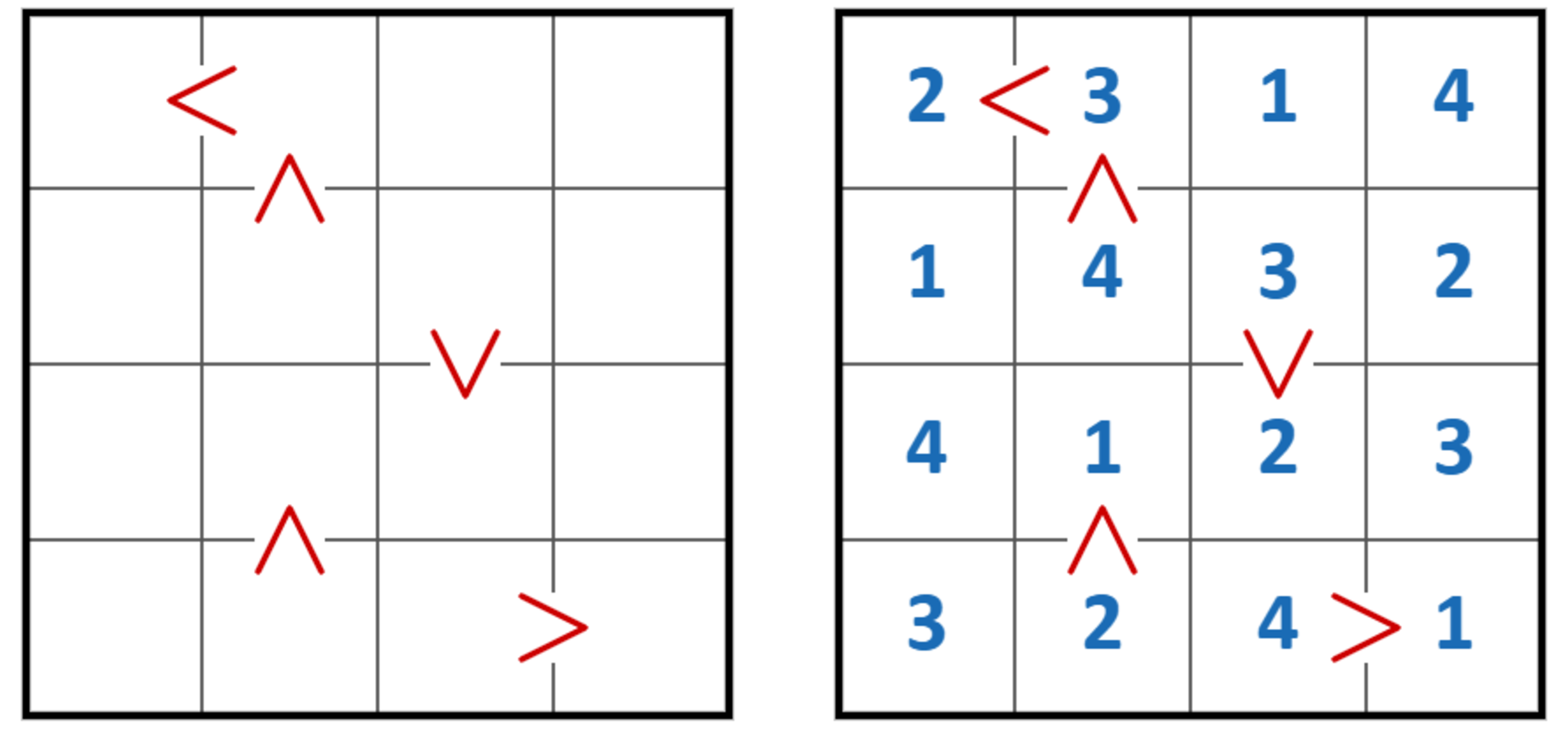
Goal: Complete the grid with the numbers 1 through N. Rules: - Each row and column must contain every number from 1 to N exactly once. - Every inequality sign between adjacent cells must be true as written. - Given numbers are fixed.
- Numbers
- Logic
- Grid
The CompassPlace every listed word in the grid. Each word begins at its marked starting letter and follows its assigned compass direction. Words may overlap only on matching letters, may not pass through another word’s starting cell, and every grid cell must be used.
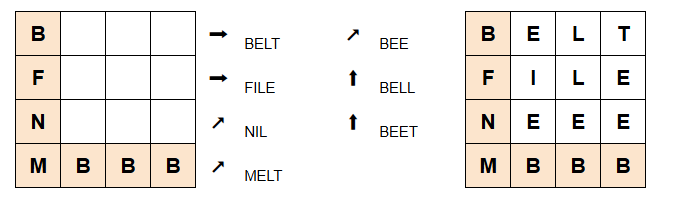
Goal: Place all listed words into the grid. Rules: - Each word starts at its marked letter and follows the compass direction assigned to its list. - Words may run horizontally, vertically, or diagonally. - Words may overlap only where the shared letter is the same. - A word cannot pass through another word’s marked starting cell. - Use every listed word exactly once and fill every grid cell.
- Word
- Logic
- Grid
Two of a KindFind the two images that are exactly identical. Compare their shape, color, orientation, pattern, and small details; every other image contains at least one difference.
Goal: Find the matching pair. Rules: - Compare every image carefully, including shape, color, orientation, pattern, and small details. - Exactly two images match in every detail. - Mark the identical pair.
- Visual
- Observation
The Perfect ShadowChoose the shadow whose silhouette matches the main picture exactly. Compare the outline, direction, pose, and every protruding or missing detail; the other shadows contain subtle changes.
Goal: Find the exact shadow of the main picture. Rules: - Compare the complete outer silhouette, including orientation, pose, and small protruding details. - Ignore shadows with any missing, added, moved, or flipped feature. - Choose the one exact match.
- Visual
- Observation
Circular MazeDetermine which outside entrance leads to the center of the circular maze. Follow open passages only and do not cross any wall.
Goal: Find the entrance that reaches the center. Rules: - Begin at one of the marked outside entrances. - Follow only open passages. - Do not cross walls or jump between rings. - Trace the route that reaches the center.
- Path
- Observation
Triangle CountCount every complete triangle formed by the drawn line segments. Include small triangles and larger triangles made from several smaller parts, and count each distinct triangle only once.
Goal: Find the total number of triangles in the figure. Rules: - Count every triangle whose three sides are completely formed by drawn line segments. - Include both small triangles and larger composite triangles. - Do not count shapes with an incomplete side. - Count each distinct triangle once.
- Visual
- Grid
- Observation
Math SquareFill the grid so every row and column matches its outside sum. Use each allowed number exactly once: normally 1–9 in a 3×3 grid or 1–16 in a 4×4 grid.
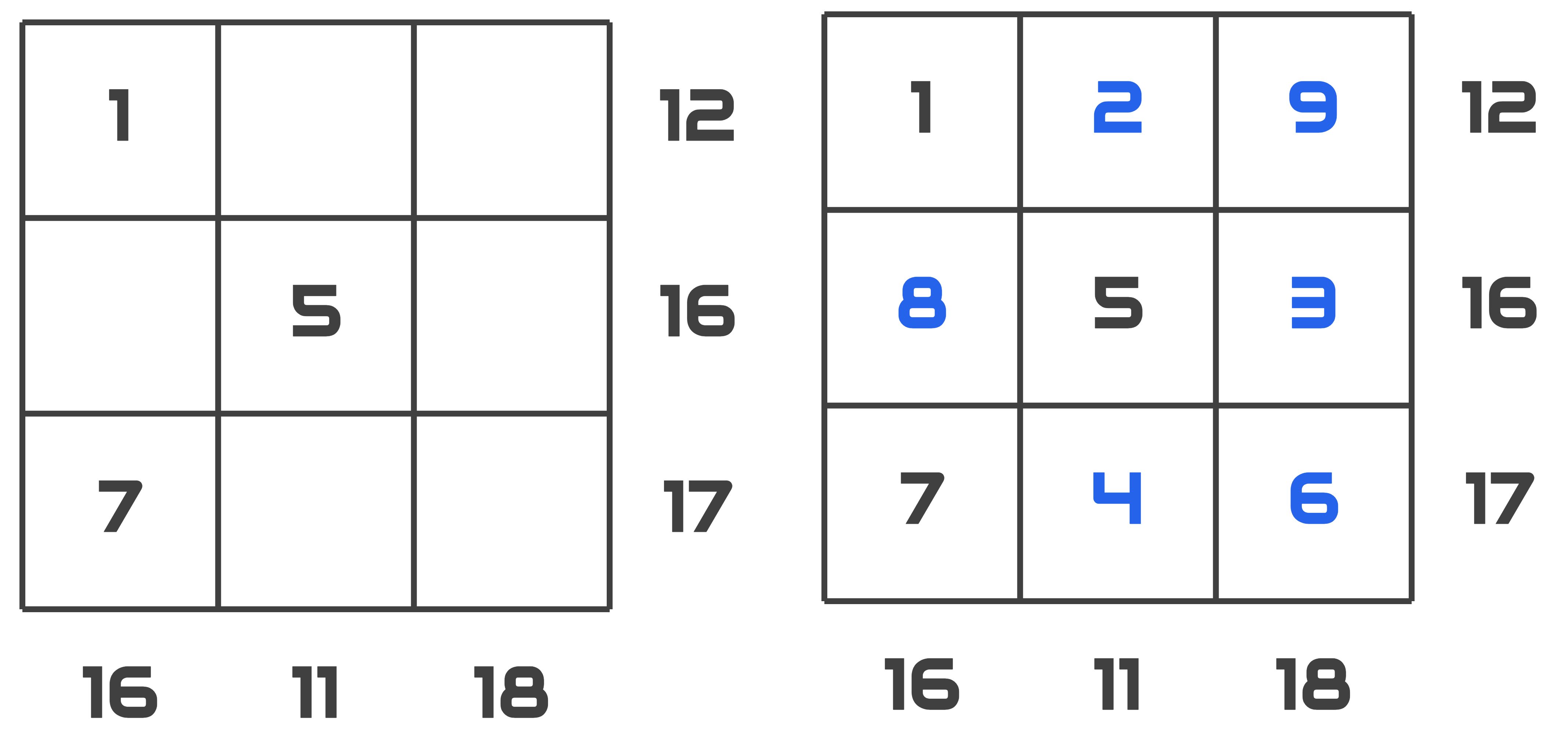
Goal: Complete the grid so all row and column sums are correct. Rules: - Use every number in the allowed range exactly once. - A 3×3 puzzle uses the numbers 1–9; a 4×4 puzzle uses the numbers 1–16, unless another range is shown. - The numbers in each row must add to its clue on the right. - The numbers in each column must add to its clue below.
- Numbers
- Math
- Logic
- Grid
- Placement
First SightPlace A, B, and C so each letter appears exactly once in every row and column; all remaining cells stay empty. Each outside clue shows the first non-empty letter visible from that direction.
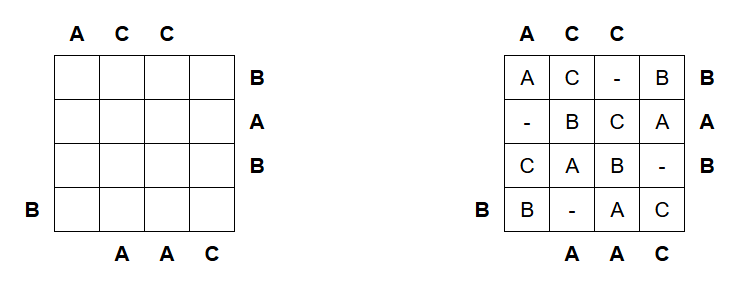
Goal: Place A, B, and C in the grid. Rules: - Each row and column must contain A, B, and C exactly once. - All other cells remain empty. - An outside clue shows the first non-empty letter seen when looking into that row or column from the clue’s side.
- Word
- Grid
- Placement
First Sight ABCDPlace A, B, C, and D so each letter appears exactly once in every row and column; all remaining cells stay empty. Each outside clue shows the first non-empty letter visible from that direction.
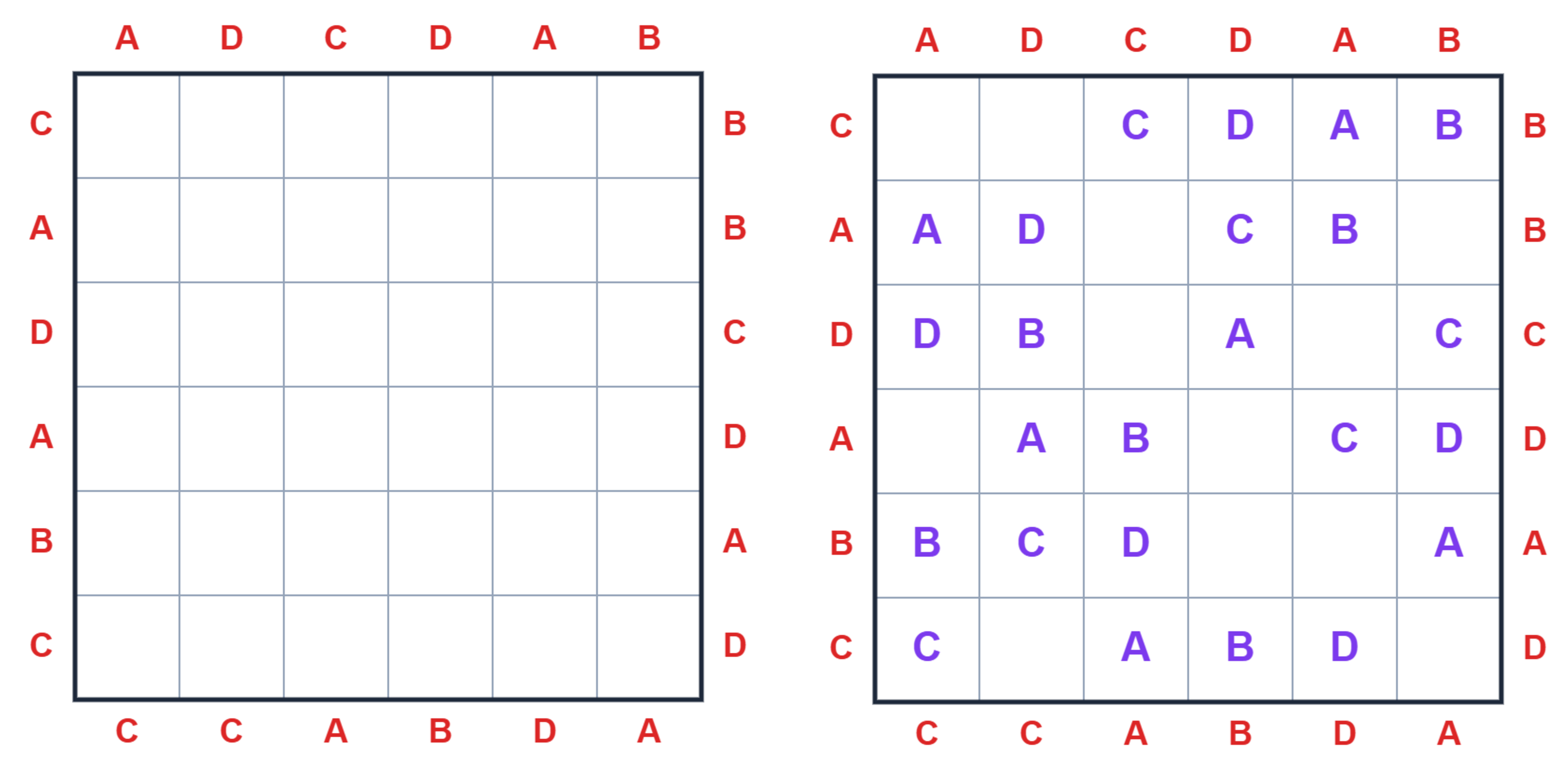
Goal: Place A, B, C, and D in the grid. Rules: - Each row and column must contain A, B, C, and D exactly once. - All other cells remain empty. - An outside clue shows the first non-empty letter seen when looking into that row or column from the clue’s side.
- Word
- Grid
- Placement
Swift SudokuComplete each 6×6 Sudoku variant with the numbers 1–6. Every row and column contains each number once. Also obey the marked regions: standard 2×3 boxes, irregular jigsaw regions, and any highlighted diagonals shown by that puzzle.
Goal: Complete each 6×6 Sudoku variant. Rules: - Every row and column must contain the numbers 1–6 exactly once. - In a standard grid, each outlined 2×3 box must also contain 1–6 exactly once. - In a jigsaw grid, each irregular outlined region must contain 1–6 exactly once. - If one or both main diagonals are marked, each marked diagonal must contain 1–6 exactly once. - Apply only the extra regions or diagonals shown on that individual puzzle.
- Sudoku
- Numbers
- Grid
- Observation
The ReefShade cells to form one connected reef with no completely shaded 2×2 area. Each clue describes the lengths of separate consecutive shaded groups around it; different groups must be separated by at least one unshaded cell.
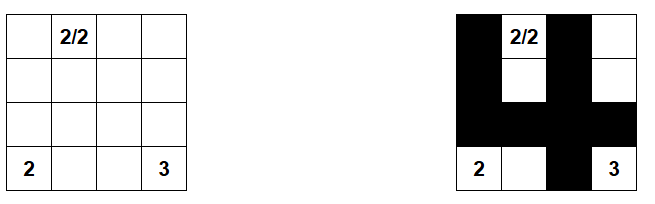
Goal: Shade cells to create the reef described by the clues. Rules: - All shaded cells must form one orthogonally connected area. - No 2×2 group of cells may be completely shaded. - The numbers in a clue give the lengths of the separate consecutive shaded groups surrounding that clue. - Separate shaded groups around a clue must have at least one unshaded cell between them. - Clue cells themselves remain unshaded.
- Numbers
- Path
- Logic
- Grid
- Shading
Secret CoderDeduce the hidden four-digit code from the guesses and feedback dots. A black dot marks a correct digit in the correct position; a white dot marks a correct digit in the wrong position. Dot order does not match digit order, and each code digit can be counted only once per guess.
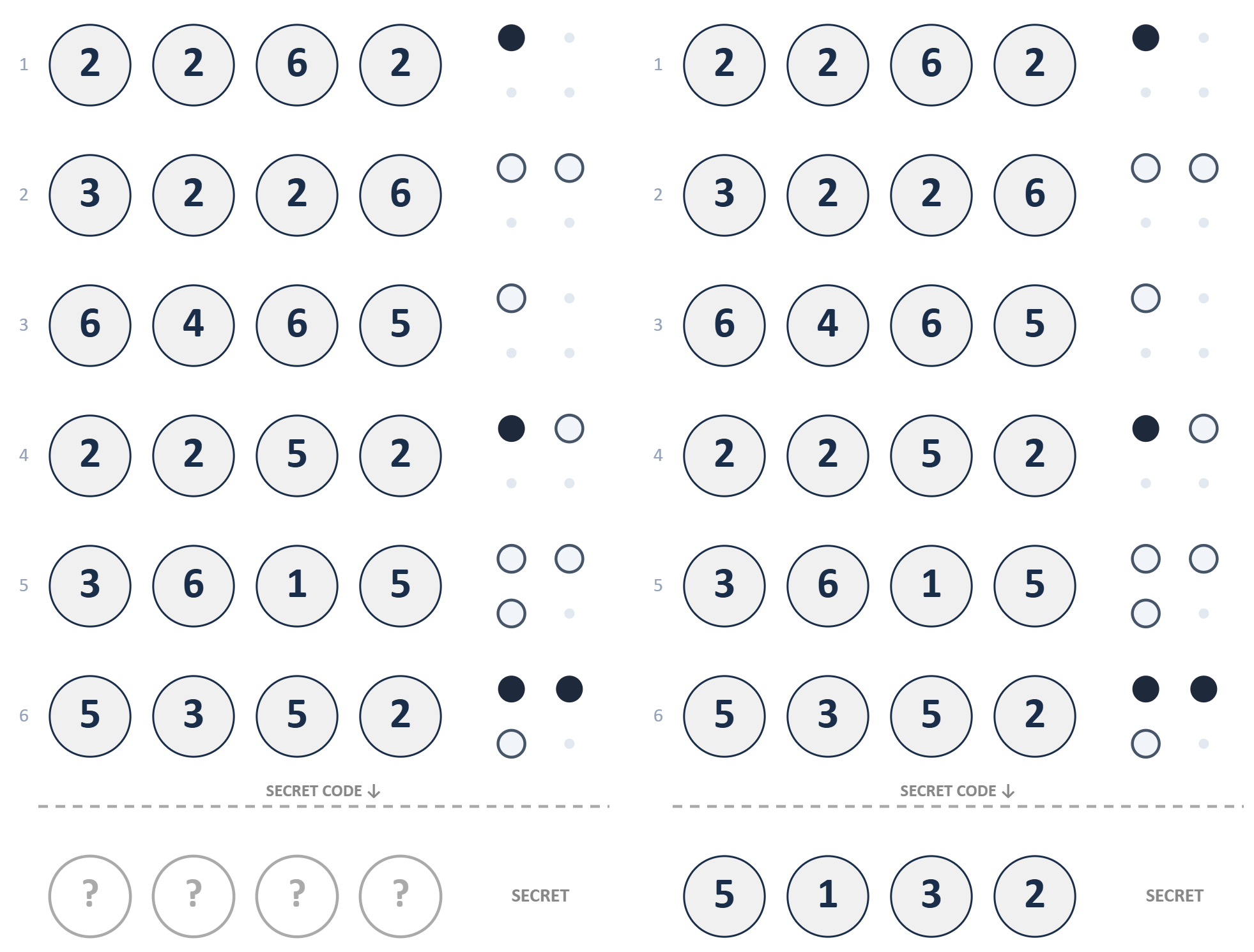
Goal: Deduce the hidden four-digit code. Rules: - Each guess receives feedback for the number of matching digit occurrences. - A black dot means one digit is correct and in the correct position. - A white dot means one remaining digit is correct but in the wrong position. - Feedback dots are not tied to specific positions and may appear in any order. - Each digit occurrence in the secret code may be matched only once per guess; an unmatched occurrence receives no dot.
- Numbers
- Word
- Logic
- Grid
- Shading
Hitori / SinglesShade cells so no number repeats among the unshaded cells of any row or column. Shaded cells cannot share an edge, and all unshaded cells must remain connected horizontally and vertically.
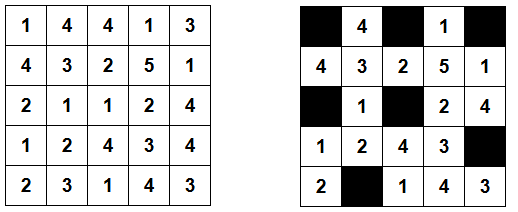
Goal: Remove all row and column duplicates by shading cells. Rules: - After shading, no number may appear more than once among the unshaded cells of any row or column. - Shaded cells hide their numbers. - Shaded cells cannot share an edge. - All unshaded cells must form one orthogonally connected area.
- Numbers
- Logic
- Grid
- Shading
Association Fill-In CrosswordSolve each association clue to find one answer word, then place all answers in the crossword grid. Use the given initial letters, answer lengths, and crossing letters to determine where every word belongs.

Goal: Solve the association clues and complete the crossword. Rules: - Each clue group points to one related answer word. - Use any supplied starting letter and word length to identify the answer. - Place every answer in a slot of the correct length. - Crossing letters must agree in both words, and every slot must be filled.
- Word
- Logic
- Grid
- Placement
- Observation
Root SystemsConnect the numbered tree nodes with straight lines in any of the eight compass directions. Each number gives the node’s exact number of connections. Lines cannot cross, overlap, pass through another node, or duplicate a connection, and all nodes must form one network.
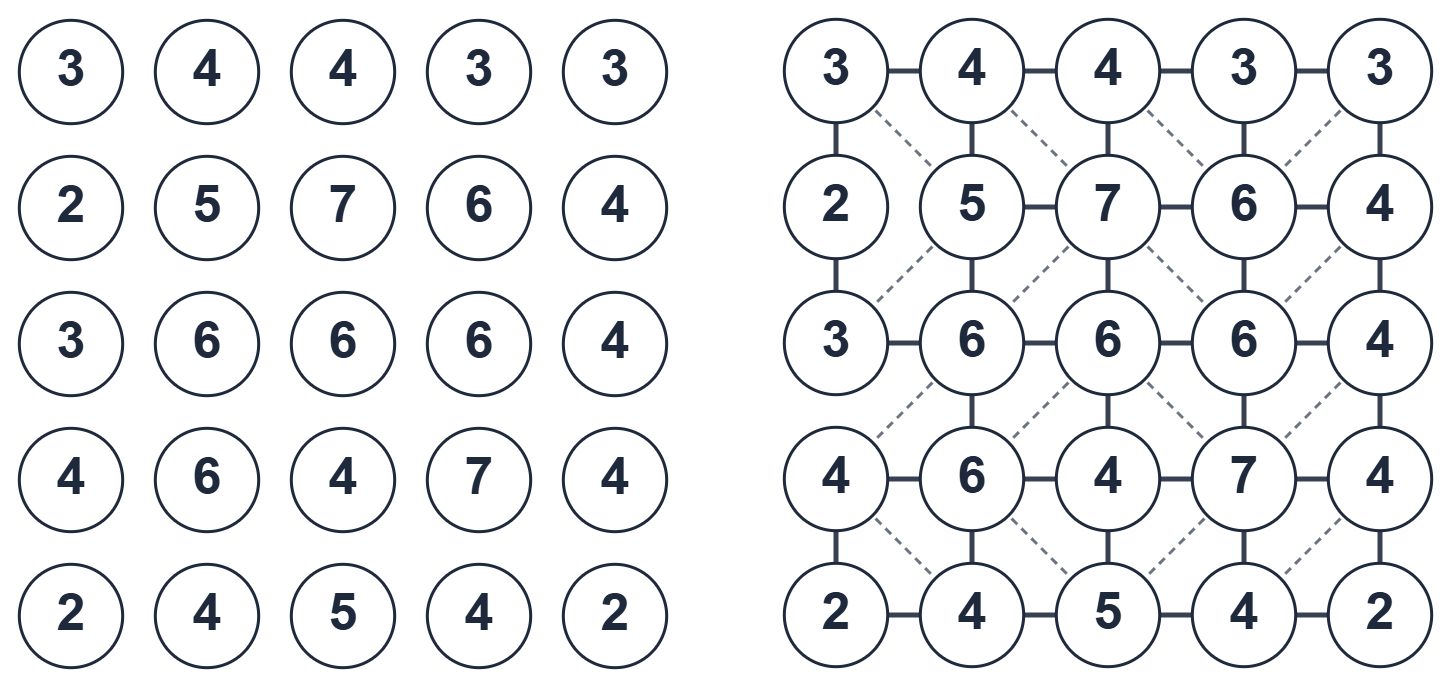
Goal: Connect all tree nodes into one network. Rules: - Connections are straight and may run horizontally, vertically, or diagonally. - The number inside a node gives its exact total number of connections. - Only one line may connect the same pair of nodes. - Lines cannot cross, overlap, or pass through another node. - Every node must belong to the same connected network.
- Path
- Connection
- 8-Directional
The Gopher HolesLocate every hidden hole. A numbered cell is safe and shows how many holes are in its eight surrounding cells. Use the clue numbers and the stated total number of holes to mark every remaining cell as a hole or safe.
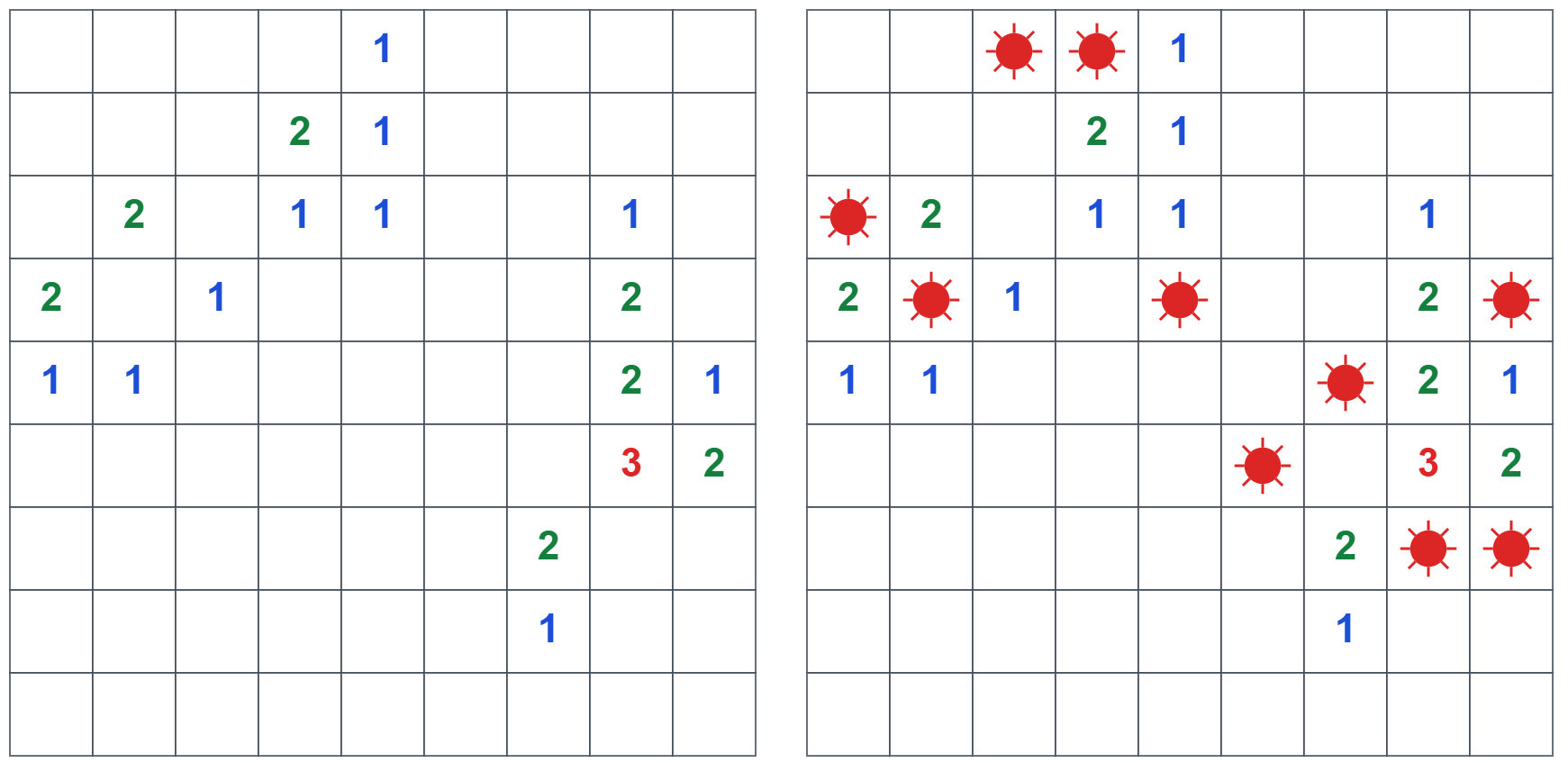
Goal: Find all hidden gopher holes. Rules: - A numbered cell is always safe and cannot contain a hole. - Its number gives the exact count of holes in the up to eight cells touching it horizontally, vertically, or diagonally. - The puzzle also gives the total number of holes in the grid. - Mark every possible cell as either a hole or safe.
- Logic
- Grid
- Placement
Word SearchFind every listed word in the letter grid. Words may run horizontally, vertically, or diagonally in either direction and may share letters. Use any unused letters only when the puzzle specifically asks for a final message.
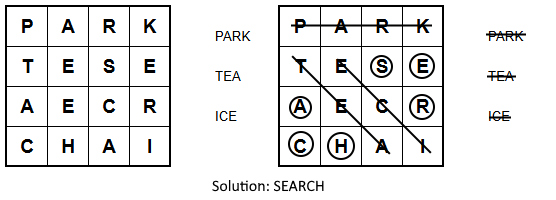
Goal: Find all listed words. Rules: - Words may run horizontally, vertically, or diagonally. - Words may be read forward or backward. - Different words may share letters. - If the puzzle includes a hidden-message instruction, read the remaining letters in the stated order.
- Word
- Grid
- Placement
- Observation
Odd One OutFind the single item that differs from all the others. Compare shape, color, orientation, pattern, position, and small missing or added details before choosing.
Goal: Find the one item that does not match the pattern. Rules: - Compare all items across the full image or grid. - Check shape, color, orientation, pattern, position, and small details. - Exactly one item is the odd one out.
- Visual
- Grid
- Observation
Two of a KindFind the two images that are exactly identical. Compare their shape, color, orientation, pattern, and small details; every other image contains at least one difference.
Goal: Find the matching pair. Rules: - Compare every image carefully, including shape, color, orientation, pattern, and small details. - Exactly two images match in every detail. - Mark the identical pair.
- Visual
- Observation
Square MazeFind a continuous route from the entrance to the exit. Move only through open passages, never cross a wall, and do not move diagonally through corners.
Goal: Reach the exit from the entrance. Rules: - Move through open passages only. - Do not cross walls. - Do not move diagonally through corners. - Trace one continuous route to the exit.
- Path
- Grid
- Observation
Path FinderTrace the tangled lines from the marked starting points and identify which one reaches the target. At visual crossings, remain on the same uninterrupted line; do not switch from one path to another.
Goal: Find the starting path that reaches the target. Rules: - Begin at each marked starting point and follow its line. - When lines cross visually, continue along the same uninterrupted line. - Do not jump or switch to another path at a crossing. - Choose the path that reaches the target rather than a dead end.
- Path
- Visual
- Observation
Out FishingDraw one fishing line from each numbered border angler to one fish. The number gives the exact line length, including the border entry cell and fish cell. Lines move orthogonally, cannot cross or share cells, and every non-black cell must belong to one line.
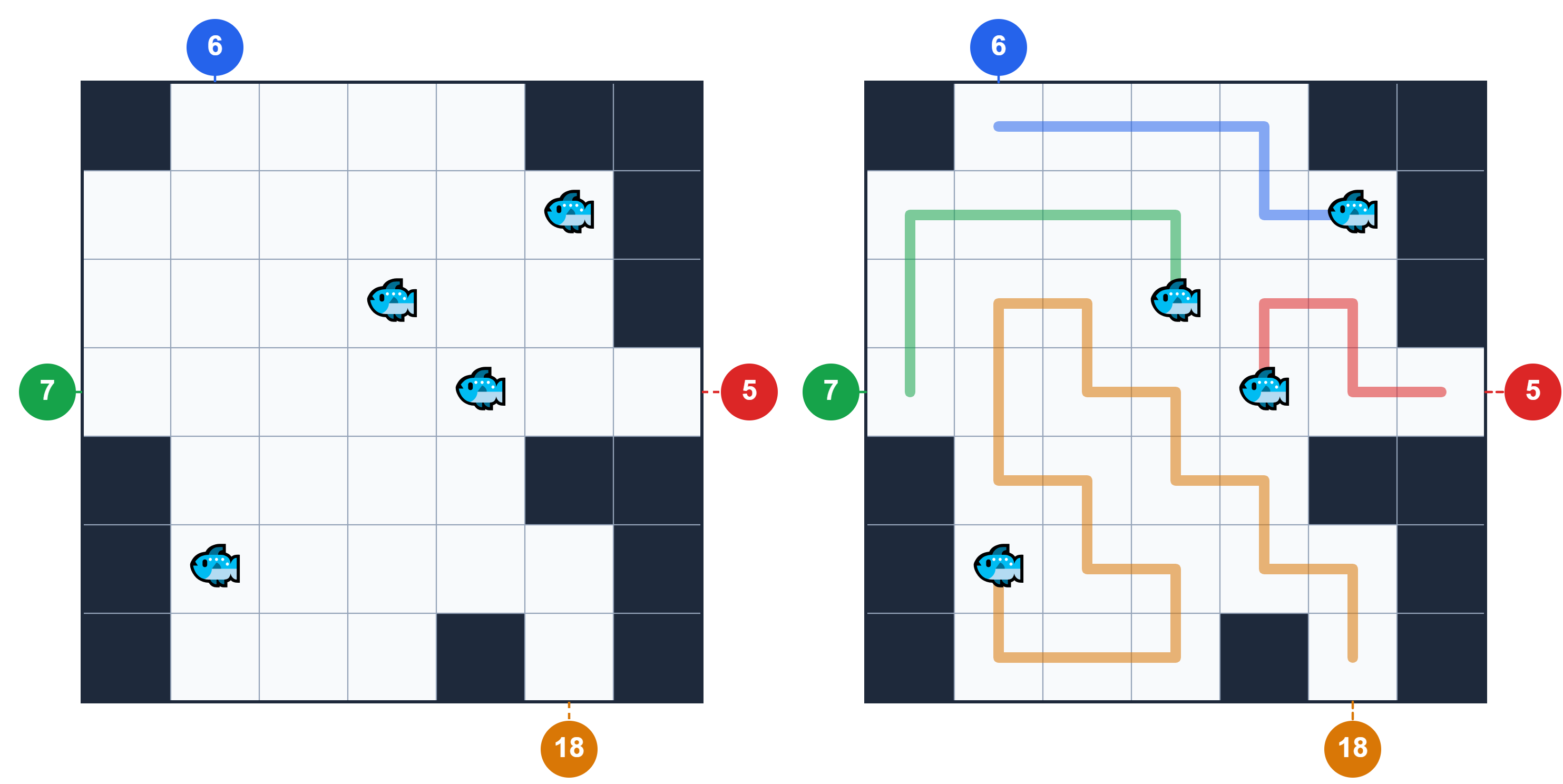
Goal: Pair every border angler with exactly one fish. Rules: - Each angler’s number gives the exact length of its line, counting the border entry cell and the fish cell. - Lines move horizontally or vertically and may turn. - Lines cannot cross, overlap, share cells, or pass through black cells. - Every fish is used once, and every non-black grid cell belongs to exactly one fishing line.
- Numbers
- Path
- Logic
- Grid
Fish FinderIdentify which item from the reference list is missing from the main picture. Compare colors, shapes, orientation, and distinctive details, then select the one reference item that does not appear.
Goal: Find the missing reference item. Rules: - Compare every reference option with the main picture. - Match color, shape, orientation, and distinctive details. - Exactly one reference item does not appear in the picture.
- Visual
- Observation
Domino PuzzlesDivide the number grid into horizontal or vertical dominoes so every cell belongs to exactly one domino. Each domino from the required set must appear exactly once, and dominoes cannot overlap.
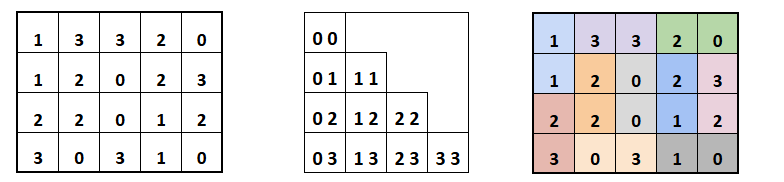
Goal: Find every domino boundary in the number grid. Rules: - Each domino covers two orthogonally adjacent cells. - Every grid cell belongs to exactly one domino. - Dominoes cannot overlap. - Each unordered number pair in the required domino set must be used exactly once.
- Numbers
- Grid
- Placement
- Observation
Sudoku 6×6Complete the 6×6 Sudoku with the numbers 1–6. Each number must appear exactly once in every row, every column, and every outlined 2×3 box.
Goal: Complete the 6×6 Sudoku grid. Rules: - Each row must contain the numbers 1–6 exactly once. - Each column must contain the numbers 1–6 exactly once. - Each outlined 2×3 box must contain the numbers 1–6 exactly once. - Given numbers are fixed.
- Sudoku
- Numbers
- Grid
- Placement
- Observation
Number CrunchChoose exactly four of the given numbers and combine them to reach the target. Use each chosen number once, with +, −, ×, ÷, and parentheses as needed. A number may be reused only if it appears more than once in the list.
Goal: Create an equation equal to the target value. Rules: - Choose exactly four numbers from the supplied list. - Use each chosen occurrence exactly once. - You may use +, −, ×, ÷, and parentheses. - Do not reuse a number unless that number appears more than once in the list. - The final result must equal the target exactly.
- Numbers
- Math
Icon AlgebraUse the earlier equations to find the value of each icon, then solve the final expression. Identical icons have the same value unless their appearance or quantity changes. Apply normal arithmetic and the standard order of operations.
Goal: Determine each icon’s value and solve the final expression. Rules: - Use the earlier equations to calculate the value of each icon. - Identical icons represent the same value unless the image is visibly changed. - Count repeated icons carefully and notice any changed operators or quantities. - Use the standard order of operations in the final expression.
- Numbers
- Math
- Visual
- Logic
- Grid
- Observation
Math CrosswordFill the empty number cells so every horizontal and vertical equation is correct. Use each number from 1 to 15 exactly once, unless a different range is printed on the puzzle.
Goal: Complete every equation in the grid. Rules: - Place each number from 1 to 15 exactly once, unless the puzzle shows a different number range. - Read and solve each horizontal or vertical equation in the direction displayed. - Every completed equation must be mathematically correct. - Given numbers and operators are fixed.
- Numbers
- Math
- Word
- Grid
- Observation
Classic SudokuComplete the 9×9 Sudoku so the numbers 1–9 appear exactly once in every row, every column, and every 3×3 box.
Goal: Complete the 9×9 Sudoku grid. Rules: - Each row must contain the numbers 1–9 exactly once. - Each column must contain the numbers 1–9 exactly once. - Each 3×3 box must contain the numbers 1–9 exactly once. - Given numbers are fixed.
- Sudoku
- Numbers
- Logic
- Grid
Sudoku XComplete the 9×9 Sudoku so every row, column, 3×3 box, and both main diagonals contain the numbers 1–9 exactly once.
Goal: Complete the Sudoku X grid. Rules: - Each row, column, and 3×3 box must contain the numbers 1–9 exactly once. - Each of the two main corner-to-corner diagonals must also contain the numbers 1–9 exactly once. - Given numbers are fixed.
- Sudoku
- Numbers
- Grid
Hoshi SudokuFill the star-shaped grid with the allowed digits. Digits cannot repeat on any continuous straight row or diagonal line, or within any outlined large triangular region. A line of nine cells contains 1–9 exactly once; shorter lines contain no repeats.
Goal: Complete the star-shaped Sudoku grid. Rules: - Digits cannot repeat on any continuous straight line of cells. - Every line containing nine cells must contain the numbers 1–9 exactly once. - Shorter lines use digits from the allowed range without repetition. - Digits also cannot repeat within any outlined large triangular region. - Given digits are fixed.
- Sudoku
- Numbers
- Logic
- Grid
Jigsaw Sudoku / Killer SudokuComplete the Sudoku variant shown. In both types, every row and column contains 1–9 once. Jigsaw Sudoku uses irregular regions instead of 3×3 boxes. Killer Sudoku keeps the 3×3 boxes and adds cages whose digits sum to the clue without repeating.
Goal: Complete the Jigsaw Sudoku or Killer Sudoku shown. Rules: - In both variants, each row and column must contain the numbers 1–9 exactly once. - Jigsaw Sudoku: each irregular outlined region must contain 1–9 exactly once; these regions replace the standard 3×3 boxes. - Killer Sudoku: each standard 3×3 box must contain 1–9 exactly once. - Killer Sudoku cages must add to the small clue in the cage, and a digit cannot repeat within a cage.
- Sudoku
- Numbers
- Math
- Logic
- Grid
- Placement
Mosaic / NonogramShade cells to reveal the hidden picture. Row and column clues give the lengths of consecutive shaded blocks in order. Separate blocks must have at least one unshaded cell between them.
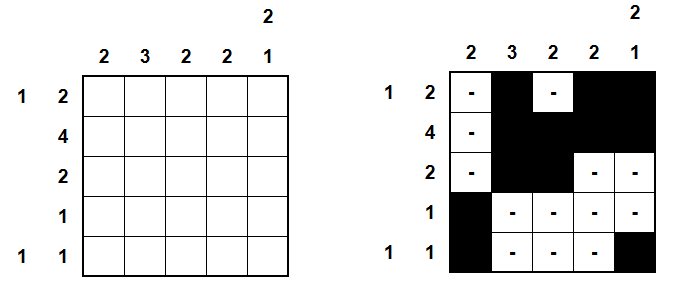
Goal: Shade the correct cells and reveal the hidden picture. Rules: - Each clue number gives the length of one consecutive shaded block in that row or column. - Multiple clue numbers appear in the same order as their shaded blocks. - Separate shaded blocks must have at least one unshaded cell between them. - Cells that cannot be shaded should be marked as empty.
- Numbers
- Logic
- Grid
- Shading
KakuroFill each white cell with a digit from 1–9. Every horizontal or vertical run must add to its clue, and no digit may repeat within a single run.
Goal: Fill all white cells so every sum clue is satisfied. Rules: - Use digits 1–9 in the white cells. - Each clue gives the sum of the consecutive white cells extending from it horizontally or vertically. - A digit cannot repeat within the same sum run. - Different crossing runs share the digit in their common cell.
- Numbers
- Math
- Visual
- Grid
ShipsPlace every ship in the displayed fleet exactly once. Row and column clues give the number of ship segments in each line. Ships are straight and horizontal or vertical, and different ships cannot touch, even diagonally.
Goal: Locate the complete hidden fleet. Rules: - Place every ship shown in the fleet list exactly once. - Ships are straight and run horizontally or vertically. - Row and column clues show the exact number of ship segments in each line. - Different ships cannot touch, even at a corner. - Any given ship parts or water cells are fixed.
- Numbers
- Logic
- Grid
- Placement
- Observation
Tents and TreesPlace one tent for every tree. Each tent must be paired with exactly one horizontally or vertically adjacent tree, and each tree must be paired with exactly one tent. Adjacency does not automatically mean pairing: a tree or tent may touch other possible partners. Tents cannot touch, even diagonally.
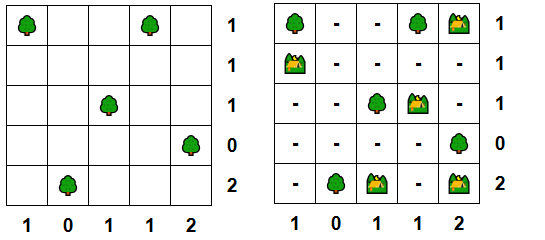
Goal: Place and pair one tent for every tree. Rules: - Every tent must be paired with exactly one tree directly beside it horizontally or vertically. - Every tree must be paired with exactly one tent. - Adjacency and pairing are different: a tree may be next to more than one tent, and a tent may be next to more than one tree, but each belongs to only one pair. - Tents cannot touch one another horizontally, vertically, or diagonally. - Row and column clues show the exact number of tents in each line.
- Numbers
- Grid
- Placement
Slitherlink / FencesDraw one closed loop along the grid lines. The loop cannot branch, cross itself, or have loose ends. A number inside a cell gives the exact number of that cell’s four sides used by the loop.
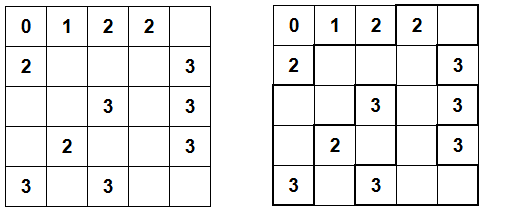
Goal: Draw one single closed loop along the grid lines. Rules: - The loop cannot branch, cross itself, overlap, or have loose ends. - A numbered cell shows exactly how many of its four sides belong to the loop. - Blank cells have no direct numerical requirement. - All drawn segments must be part of the same loop.
- Numbers
- Path
- Logic
- Grid
Matchstick EquationsMove exactly the stated number of matchsticks to make the equation correct. Each moved stick must be removed from one position and placed in another, and every resulting digit and operator must be valid.
Goal: Make the equation mathematically correct. Rules: - Move exactly the number of matchsticks stated by the puzzle. - A move consists of taking one existing stick and placing it in a new position; rotation is allowed unless the puzzle says otherwise. - Every resulting digit and operator must be valid. - Do not remove a stick without reusing it unless removal is specifically allowed.
- Numbers
- Math
- Grid
- Observation
Logic Grid PuzzleUse the clues to match each item with exactly one item in every other category. Mark confirmed matches and exclusions, then combine direct and indirect deductions until every relationship is determined.
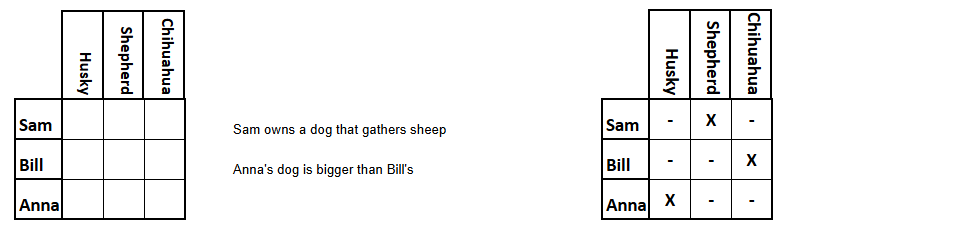
Goal: Determine all one-to-one matches across the listed categories. Rules: - Each item matches exactly one item in every other category. - Use the clues to mark definite matches and definite exclusions. - Combine direct clues with deductions created by earlier marks. - Complete the grid so every item has one consistent set of matches.
- Logic
- Grid
- Observation
Radial SudokuComplete the circular Sudoku using the allowed digit set. Each complete ring and each slice from the center to the edge must contain every allowed digit exactly once. Any outlined regions add the same no-repeat requirement.
Goal: Complete the circular Sudoku grid. Rules: - Each complete ring must contain every allowed digit exactly once. - Each radial slice from the center to the outside edge must contain every allowed digit exactly once. - Any outlined region must also contain every allowed digit exactly once. - Given digits are fixed.
- Sudoku
- Numbers
- Logic
- Grid
- Observation
Spot the DifferenceFind the stated number of differences between the two pictures. Compare them section by section for missing, added, moved, recolored, resized, or reshaped details.
Goal: Find all required differences between the two pictures. Rules: - Compare the pictures carefully, section by section. - Look for missing or added objects, moved details, color changes, size changes, and altered shapes. - Count each distinct change once. - Stop when you have found the number of differences stated by the puzzle.
- Visual
- Observation
Visual CrosswordIdentify each picture and enter its answer in the matching numbered row or column of the crossword. Use the number, slot length, and crossing letters to confirm every word.
Goal: Complete the crossword using the picture clues. Rules: - Identify the word represented by each numbered picture. - Enter that answer in the row or column carrying the same number. - The answer must fit the available number of cells. - Crossing letters must agree in both words.
- Word
- Visual
- Grid
The SunbeamsExtend horizontal or vertical rays from the numbered suns so every empty cell is covered by exactly one ray. Each sun’s clue gives the total number of cells covered by all rays from that sun. Rays cannot overlap or pass through another sun.
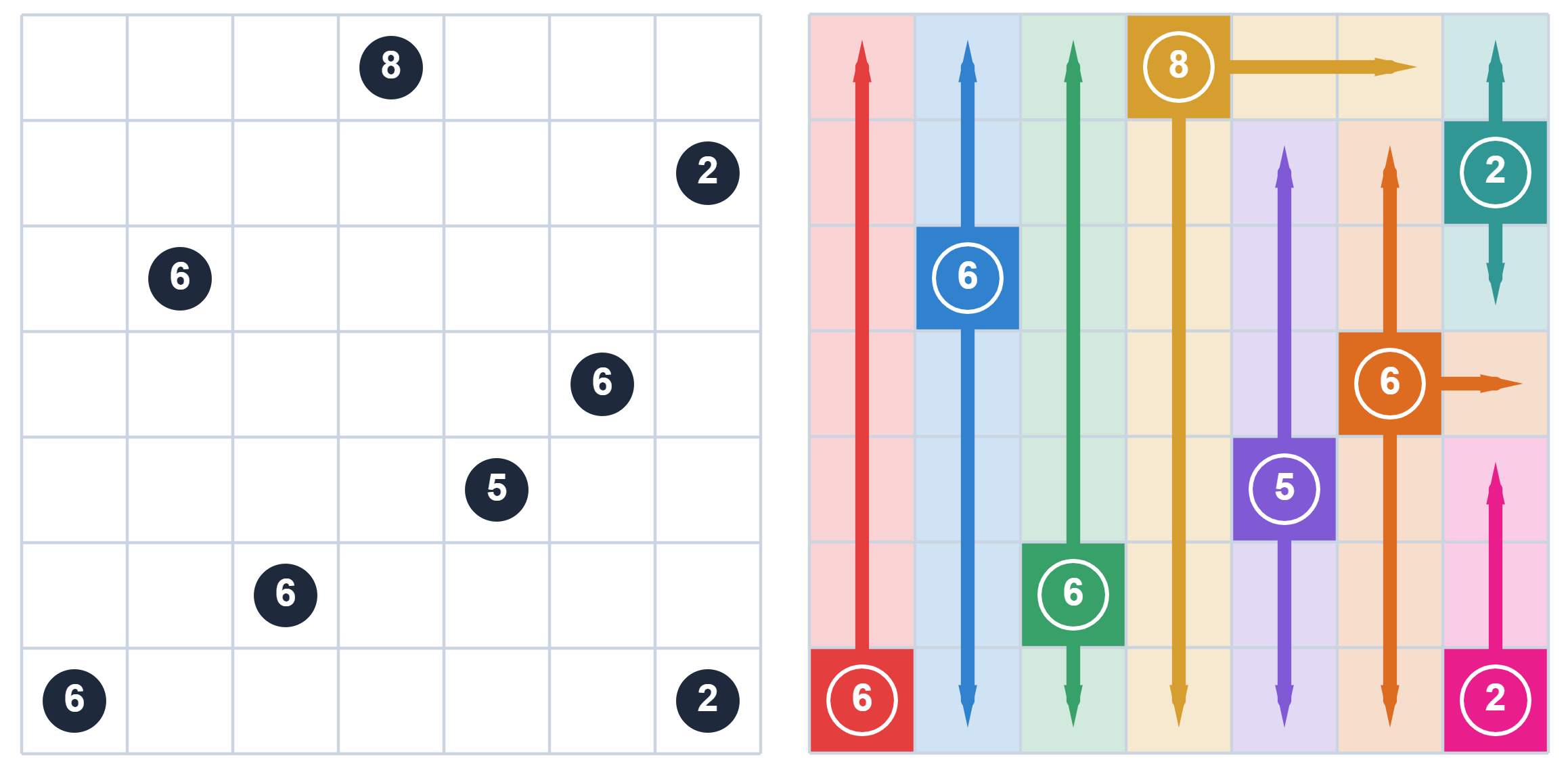
Goal: Cover the grid with rays from the numbered suns. Rules: - Rays extend horizontally or vertically from a sun. - The number on a sun gives the total number of grid cells covered by that sun’s rays. - Every empty cell must be covered by exactly one ray. - Rays cannot overlap, cross through another sun, or cover a cell assigned to a different sun.
- Logic
- Grid
- Placement
The NestFill the N×N grid with the numbers 1 through N so each number appears once in every row and column. The numbers inside each outlined nest must combine with its operation to produce the target shown.
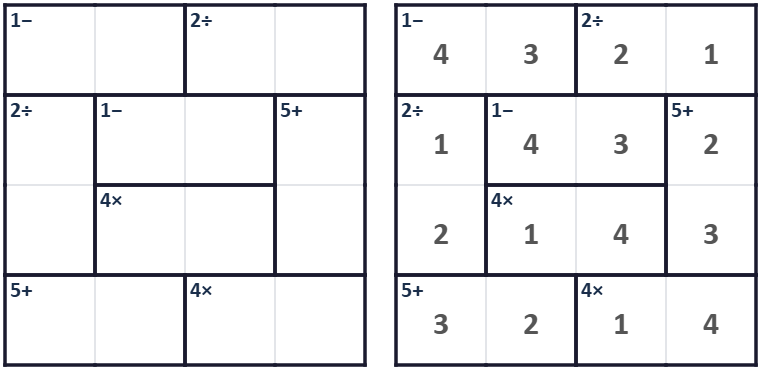
Goal: Complete the arithmetic Latin-square grid. Rules: - Each row and column must contain every number from 1 to N exactly once. - The numbers in each outlined nest must produce the target using the operation shown. - For subtraction or division nests, the numbers may be used in whichever order gives the target. - A one-cell nest contains the target number itself.
- Numbers
- Math
- Logic
- Grid
WildflowersPlace flowers so every row, column, and outlined garden zone contains exactly the number required by its clue. Flowers cannot touch one another, even diagonally.
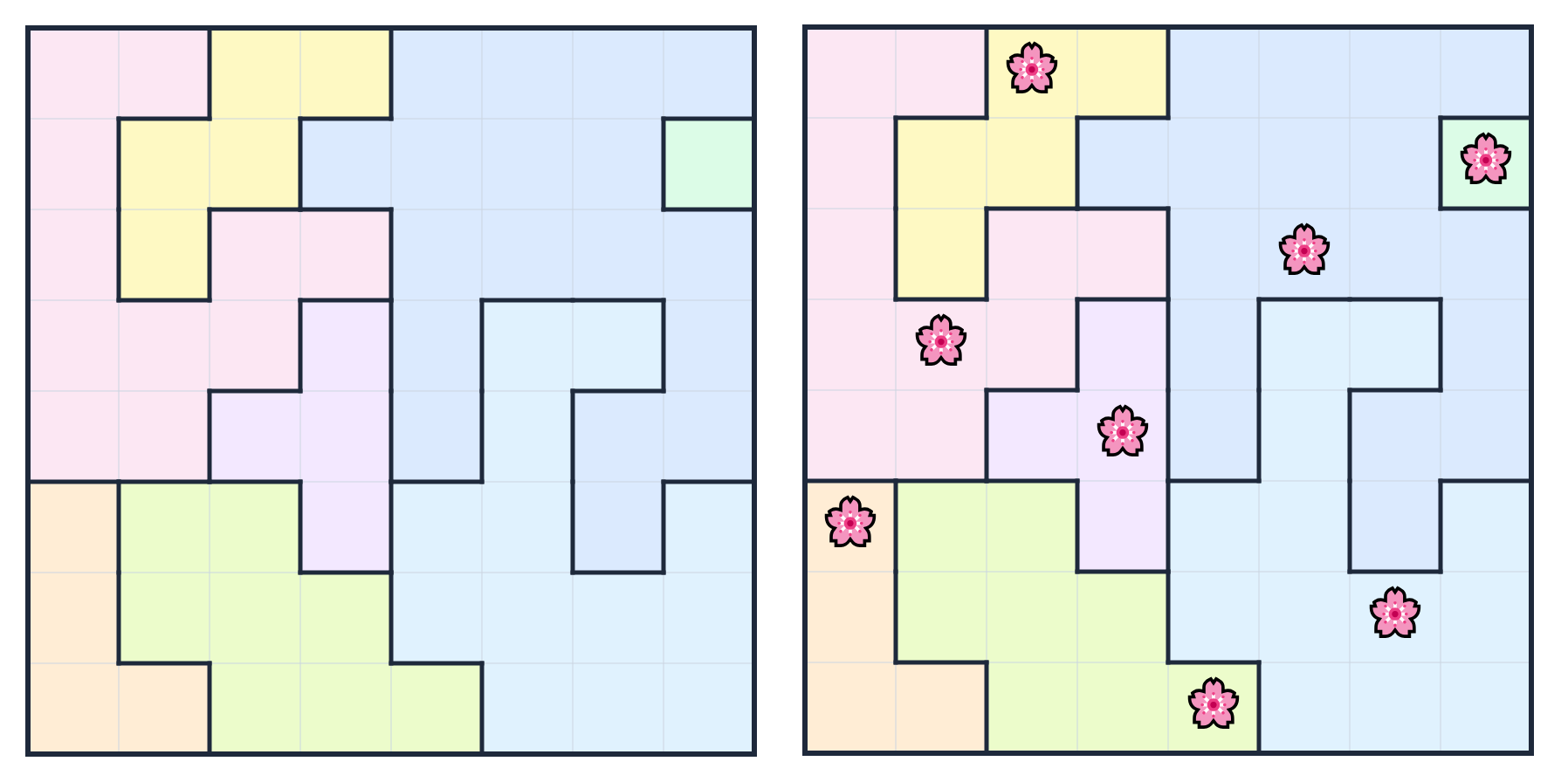
Goal: Place all required flowers in the grid. Rules: - Each row and column must contain exactly the number of flowers shown by its clue. - Each outlined garden zone must contain exactly its stated number of flowers. - Flowers cannot touch horizontally, vertically, or diagonally. - All row, column, and zone clues must be satisfied at the same time.
- Numbers
- Grid
- Placement
First Sight: Hex VersionPlace A, B, and C in the hexagonal grid. Every line in each of the three grid directions must contain A, B, and C exactly once, with all other cells empty. Each outside clue gives the first non-empty letter seen from that edge.
Goal: Place A, B, and C in the hexagonal grid. Rules: - Every complete line in each of the three grid directions must contain A, B, and C exactly once. - All remaining cells stay empty. - An outside clue shows the first non-empty letter seen when looking along that line from the clue’s edge. - Use clues from all three directions together.
- Word
- Logic
- Grid
- Placement
Neutral GridFill the grid with + and − signs. Every row and column must contain equal numbers of each sign, no three identical signs may appear consecutively horizontally or vertically, and no two completed rows or columns may be identical.
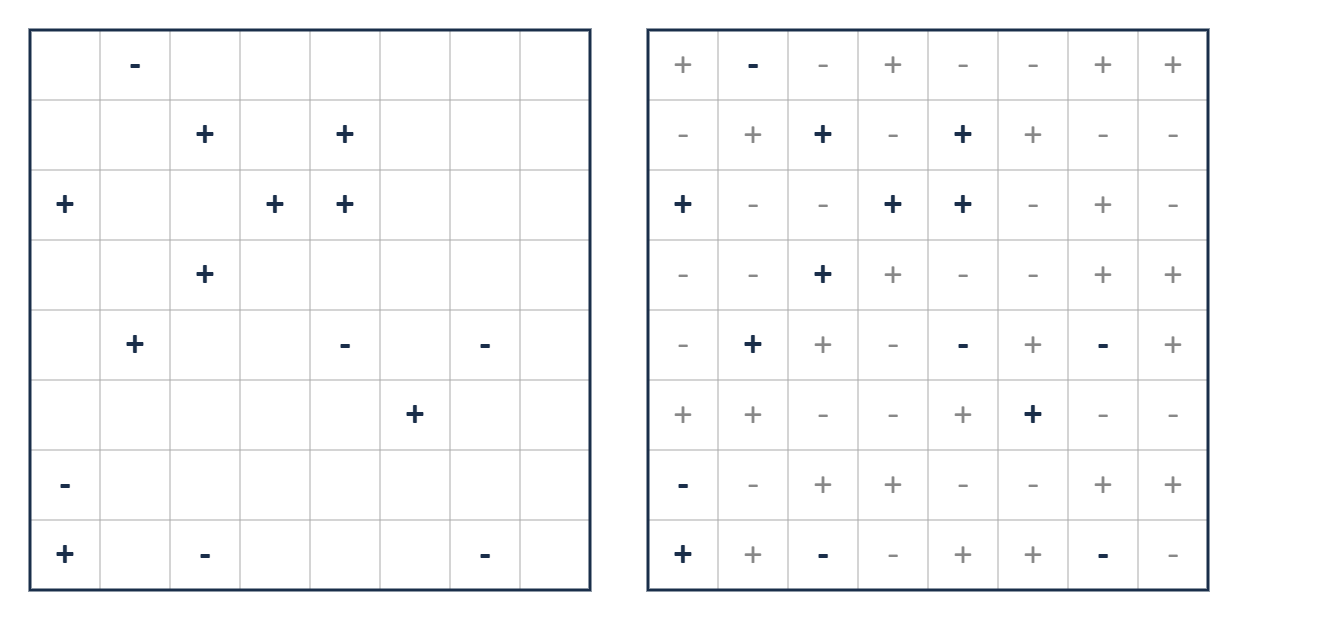
Goal: Complete the balanced + and − pattern. Rules: - Each row and column must contain the same number of + and − signs. - No three identical signs may appear consecutively in any row or column. - No two completed rows may be identical. - No two completed columns may be identical. - Given signs are fixed.
- Logic
- Grid
- Placement
TectonicFill each outlined region of N cells with the numbers 1 through N exactly once. Equal numbers cannot touch one another horizontally, vertically, or diagonally.
Goal: Complete every outlined region. Rules: - A region containing N cells must contain each number from 1 to N exactly once. - Equal numbers cannot touch horizontally, vertically, or diagonally, even when they belong to different regions. - Given numbers are fixed.
- Numbers
- Logic
- Grid
- Placement
The LookoutChoose the direction of every border arrow so it points along a straight line into the grid. Each numbered cell tells how many arrows point directly at it. Include any arrows whose directions are already fixed.
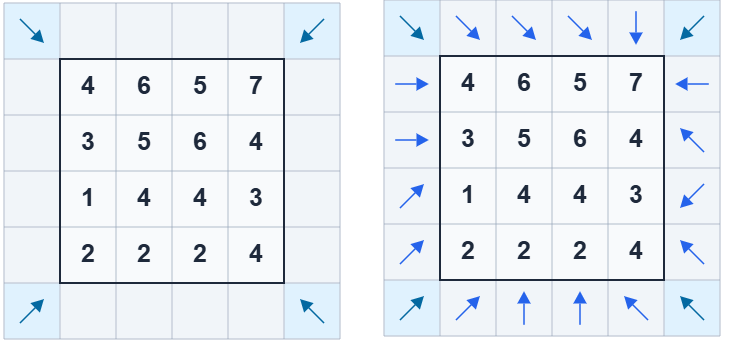
Goal: Set every border arrow direction so all numbered clues are satisfied. Rules: - Each border arrow points along a straight line into the grid. - A numbered cell shows the exact number of arrows whose line of sight points directly at that cell. - Any pre-placed arrow directions are fixed and count toward the clues. - Choose every remaining arrow direction so all clues are correct at the same time.
- Numbers
- Grid
- Placement
- Observation
CloudsShade rectangular cloud regions, each at least 2×2 unless the puzzle states otherwise. Clouds cannot overlap or touch one another, even diagonally. Row and column clues give the exact number of shaded cloud cells in each line.
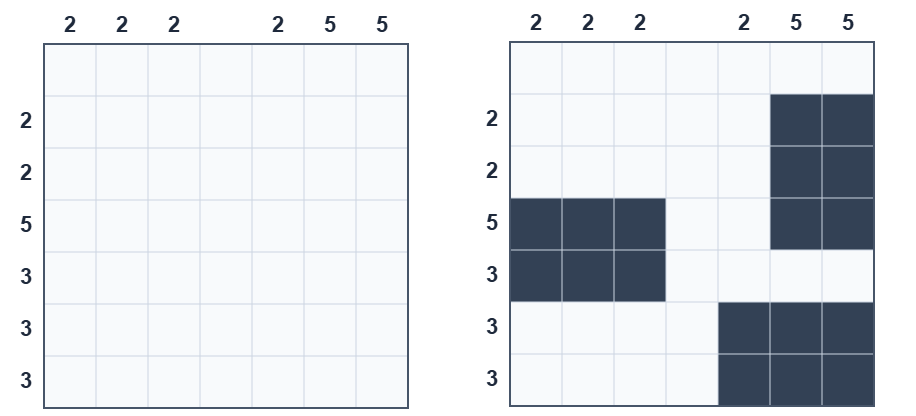
Goal: Locate all hidden cloud rectangles. Rules: - Each cloud is a solid rectangle of cells, normally at least 2×2. - Clouds cannot overlap or touch one another horizontally, vertically, or diagonally. - Row and column clues show the exact number of cloud cells in each line. - Every shaded cell must belong to one cloud rectangle.
- Numbers
- Logic
- Grid
- Shading
Tiled SudokuTreat every merged tile as one logical cell. Each physical row, column, and outlined 4×4 block must contain 1–9 once. Across the full grid, the nine top-left merged tiles, nine centered merged tiles, and nine bottom-right merged tiles must also each contain 1–9 exactly once.
Goal: Complete the Tiled Sudoku with digits 1–9. Rules: - Every merged tile is one logical cell, and all physical squares belonging to that tile share one value. - Every unmerged square is one logical cell. - Each outlined 4×4 block contains nine logical cells and must use digits 1–9 exactly once. - Each physical row and column must use digits 1–9 exactly once when repeated squares from the same merged tile are counted as one logical value. - The nine top-left merged tiles across the grid must contain digits 1–9 exactly once. - The nine centered merged tiles across the grid must contain digits 1–9 exactly once. - The nine bottom-right merged tiles across the grid must contain digits 1–9 exactly once. - Given digits are fixed.
- Sudoku
- Numbers
- Logic
- Grid
- Variant
Sudoku ShapesComplete the 9×9 Sudoku using both the usual Sudoku rules and the permanent shape clues in every cell. A circle means the digit is 1, 2, or 3; a square means 4, 5, or 6; and a cell without a shape means 7, 8, or 9.
Goal: Complete the 9×9 Sudoku Shapes grid. Rules: - Each row, column, and 3×3 box must contain the numbers 1–9 exactly once. - A circle marks a cell whose value must be 1, 2, or 3. - A square marks a cell whose value must be 4, 5, or 6. - A cell without a shape must contain 7, 8, or 9. - Shape clues apply to every cell and remain visible even when the digit is given. - Given numbers are fixed.
- Sudoku
- Numbers
- Logic
- Grid
- Variant
N-Sudoku / Double SudokuComplete every overlapping 9×9 Sudoku grid. Each individual grid must contain 1–9 exactly once in every row, column, and 3×3 box. Grids overlap in shared 3×3 corner boxes, so each shared cell has one value that must satisfy both grids.
Goal: Complete all overlapping Sudoku grids. Rules: - Each constituent 9×9 grid follows standard Sudoku rules. - Every row, column, and 3×3 box within each grid must contain digits 1–9 exactly once. - Neighboring grids overlap in a shared 3×3 corner box. - An overlapping cell is a single shared cell: its digit belongs to and must satisfy every grid covering that position. - With two grids, this forms the classic Double Sudoku layout. Five grids form the familiar Samurai-style layout. - Given numbers are fixed.
- Sudoku
- Numbers
- Logic
- Grid
- Variant
Greater & Less-Than SudokuComplete the 9×9 Sudoku so every row, column, and 3×3 box contains 1–9 exactly once. Inequality symbols between neighboring cells must be true; the pointed end of each symbol faces the cell containing the smaller number.
Goal: Complete the Greater & Less-Than Sudoku. Rules: - Each row, column, and 3×3 box must contain digits 1–9 exactly once. - Every inequality symbol compares the two horizontally or vertically adjacent cells beside it. - The pointed end of <, >, ^, or v faces the cell containing the smaller number; the open end faces the larger number. - Only displayed symbols impose an inequality. A gap without a symbol gives no extra relationship between its cells. - Given numbers are fixed.
- Sudoku
- Numbers
- Logic
- Grid
- Inequality
- Variant
Stars and ArrowsPlace stars so each arrow sees exactly one star in the straight direction it points, and every star is seen by exactly one arrow. Edge clues give the exact number of stars in each row and column.
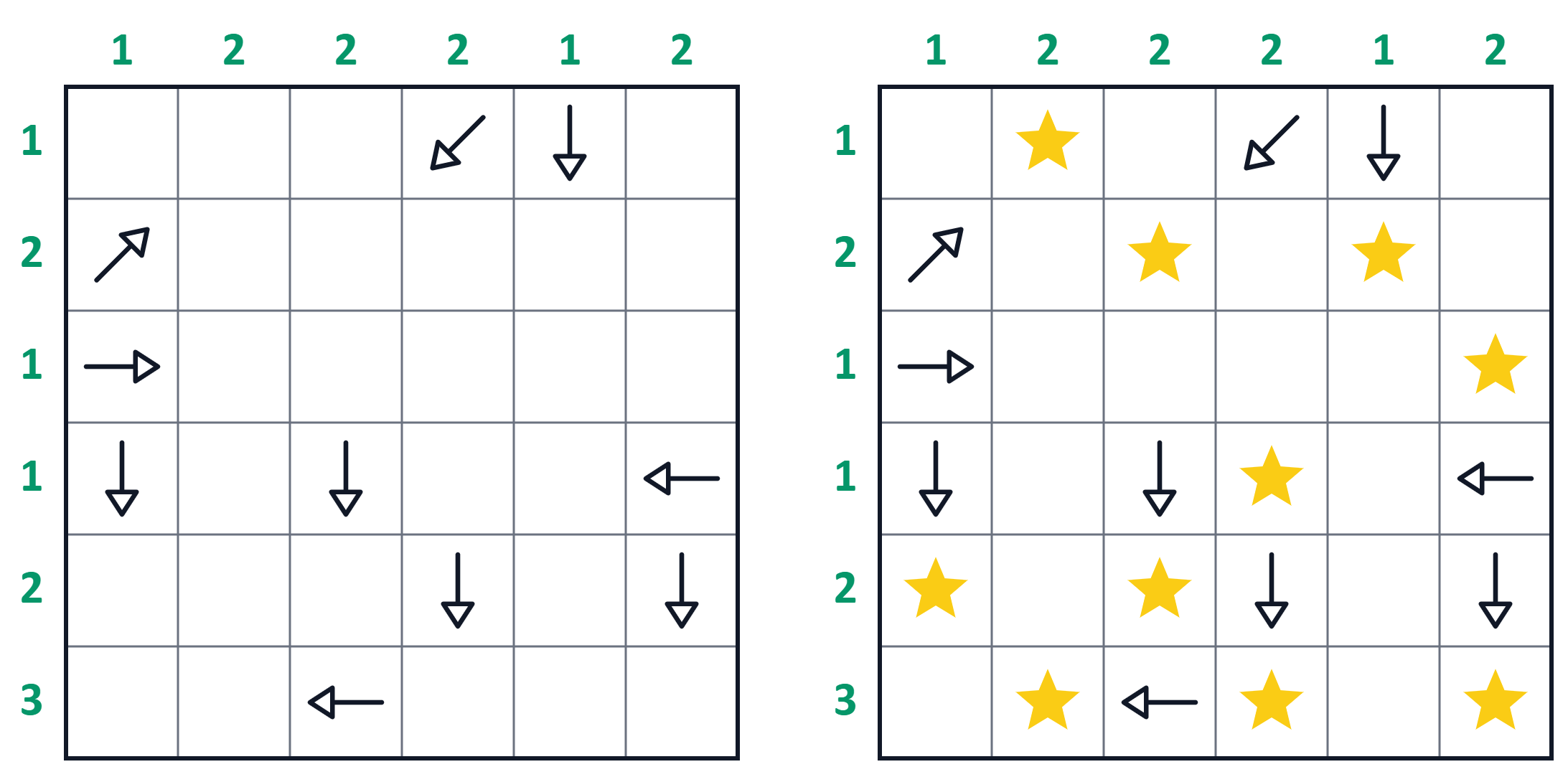
Goal: Place all stars so every arrow and edge clue is satisfied. Rules: - An arrow looks along a straight line in the direction it points. - Exactly one cell in that arrow’s line of sight must contain a star. - Every placed star must be seen by exactly one arrow. - Edge clues show the exact number of stars in each row and column.
- Logic
- Grid
- Placement
- Observation
Line SudokuComplete the 9×9 Sudoku so every row, column, and 3×3 box contains 1–9 exactly once. The nine cells touched by the winding line must also contain 1–9 exactly once, in any order.
Goal: Complete the 9×9 Line Sudoku. Rules: - Each row, column, and 3×3 box must contain the numbers 1–9 exactly once. - The winding line passes through exactly nine cells. - The nine cells touched by the line must also contain the numbers 1–9 exactly once, in any order. - Given numbers are fixed.
- Sudoku
- Numbers
- Logic
- Grid
- Variant
Consecutive SudokuComplete the 9x9 Sudoku. Every horizontally or vertically adjacent pair of consecutive numbers is marked with a dot. If two adjacent cells have no dot between them, their numbers cannot be consecutive.
Goal: Complete the 9x9 Consecutive Sudoku. Rules: - Each row, column, and 3x3 box must contain the numbers 1-9 exactly once. - A dot between two horizontally or vertically adjacent cells means their numbers differ by exactly 1. - Every adjacent consecutive pair is marked, including pairs between two given numbers. - If two adjacent cells have no dot between them, their numbers must not be consecutive. - Given numbers are fixed.
- Sudoku
- Numbers
- Logic
- Grid
- Variant
TriliaPlace 1, 2, and 3 once in every row, column, and outlined irregular region. Regions may have different shapes and sizes. Equal numbers cannot touch, even diagonally, and all remaining cells stay empty.
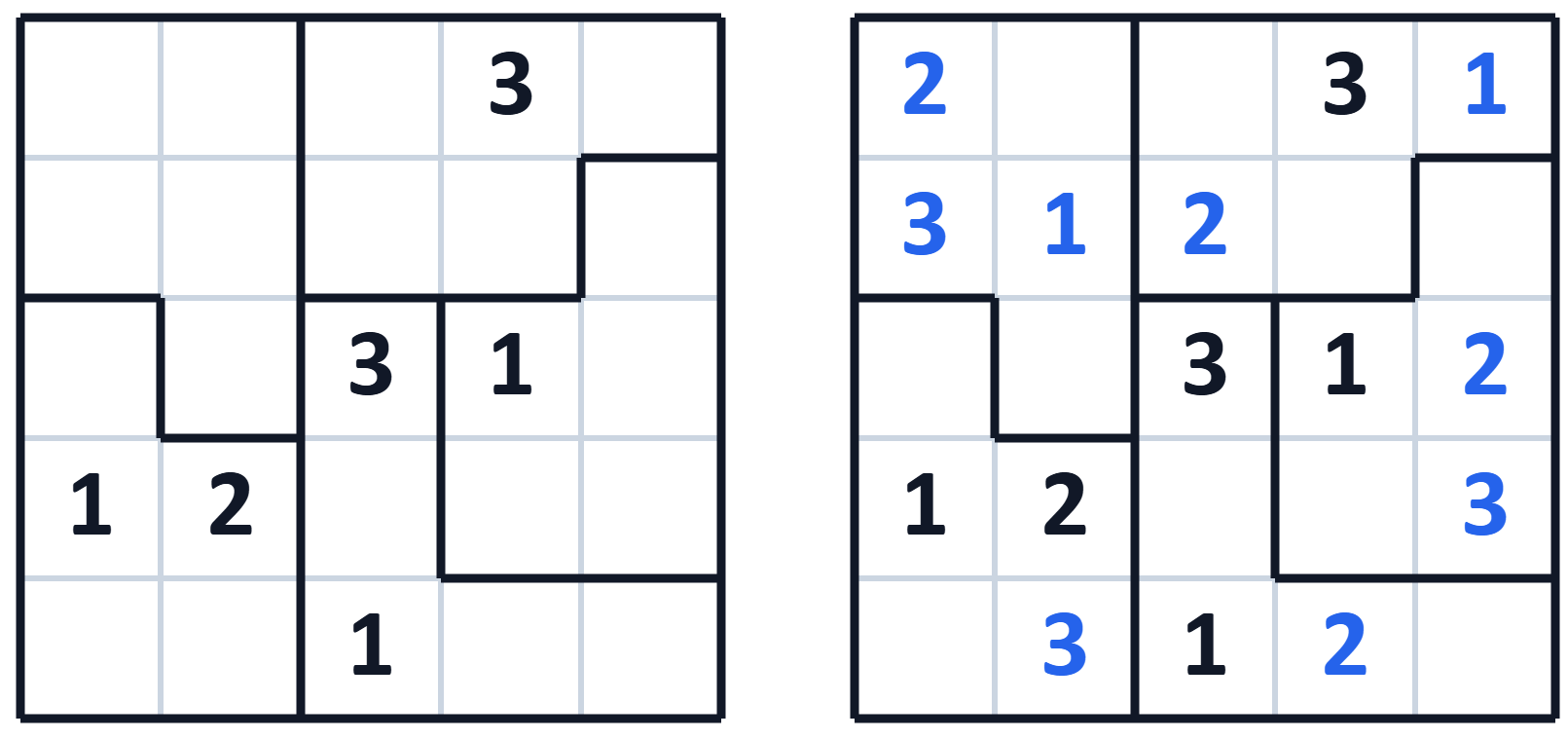
Goal: Place 1, 2, and 3 throughout the grid. Rules: - Every row contains 1, 2, and 3 exactly once. - Every column contains 1, 2, and 3 exactly once. - Every outlined irregular region contains 1, 2, and 3 exactly once. - Regions may have different shapes and sizes. Any additional cells in a region remain empty. - Equal numbers cannot touch horizontally, vertically, or diagonally. - Different numbers may touch. - All remaining cells stay empty. - Given numbers are fixed.
- Logic
- Grid
- Placement
- Symbols
Blocked First SightPlace A, B, and C once in every uninterrupted horizontal or vertical white section containing at least three cells. Black cells separate sections, so a row or column may contain more than one ABC set. Outside clues show the first letter seen and look through black and empty cells.
Goal: Place A, B, and C in every qualifying white section. Rules: - Every uninterrupted horizontal or vertical section of three or more white cells must contain A, B, and C exactly once. - Any additional cells in that section remain empty. - Black cells separate sections, so one row or column may contain several ABC sets. - Outside clues show the first letter seen from that direction. - Black and empty cells do not block the outside sight clues.
- Word
- Logic
- Grid
- Placement
- Variant
First Sight TriliaPlace A, B, and C once in every row, column, and outlined irregular region. Regions may have different shapes and sizes. Equal letters cannot touch, even diagonally. Outside clues show the first letter visible from that side; empty cells do not block sight.
Goal: Place A, B, and C throughout the grid. Rules: - Every row, column, and outlined irregular region contains A, B, and C exactly once. - Regions may have different shapes and sizes. Any additional cells in a region remain empty. - Equal letters cannot touch horizontally, vertically, or diagonally. - All remaining cells stay empty. - Outside clues show the first letter visible from that direction. - Empty cells do not block sight.
- Word
- Logic
- Grid
- Placement
- Sightline
- Variant
Four WindsExtend straight arms from every numbered cell in the four cardinal directions. A number gives the combined length of all arms extending from that cell. Arms cannot cross, overlap, leave the grid, or pass through another numbered cell, and every empty cell must be covered exactly once.
Goal: Cover every empty cell with an arm extending from a numbered cell. Rules: - Arms extend horizontally or vertically from numbered cells. - A number equals the combined length of all arms extending from that cell; the numbered cell itself is not counted. - A numbered cell may extend arms in one or more of the four cardinal directions. - Arms cannot cross, overlap, leave the grid, or pass through another numbered cell. - Every non-numbered cell must be covered by exactly one arm.
- Numbers
- Logic
- Grid
- Placement
ThermometersDetermine the mercury level in every thermometer. Mercury fills continuously from the round bulb toward the open end and cannot leave gaps. Numbers outside the grid show exactly how many cells contain mercury in each row and column. Any red pre-filled cells or grey striped empty thermometers are fixed hints.
Goal: Determine how much mercury is contained in every thermometer. Rules: - Mercury fills each thermometer continuously from its round bulb toward the open end. - A thermometer may be completely empty, partially filled, or completely full. - Mercury cannot float above an empty section or leave gaps inside a thermometer. - Numbers outside the grid show exactly how many filled cells appear in each row and column. - Red cells are pre-filled mercury hints and must remain filled. - A grey striped thermometer marked 0 is revealed as completely empty. - Use all thermometer shapes and the row and column counts to determine the unique solution.
- Numbers
- Logic
- Grid
- Placement
Six WindsExtend straight arms from every numbered cell in the six directions. A number gives the combined length of all arms extending from that cell. Arms cannot cross, overlap, leave the grid, or pass through another numbered cell, and every empty cell must be covered exactly once.
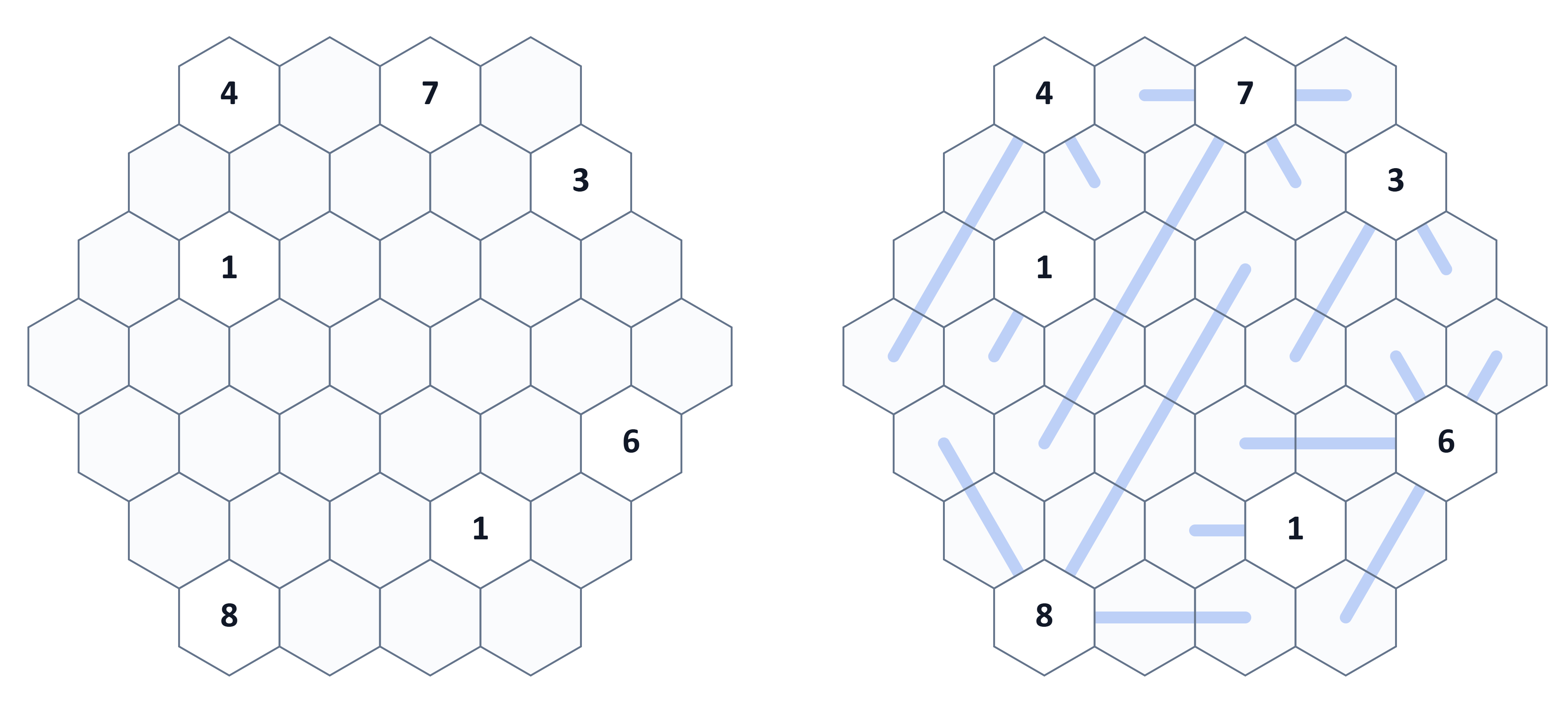
Goal: Cover every empty cell with an arm extending from a numbered cell. Rules: - Arms extend in six directions from numbered cells. - A number equals the combined length of all arms extending from that cell; the numbered cell itself is not counted. - A numbered cell may extend arms in one or more of the six directions. - Arms cannot cross, overlap, leave the grid, or pass through another numbered cell. - Every non-numbered cell must be covered by exactly one arm.
- Numbers
- Logic
- Grid
- Placement
SlantDraw a diagonal line inside every cell. Numbers at the grid intersections show exactly how many diagonal lines meet at that point. Diagonal lines must never form a closed loop.
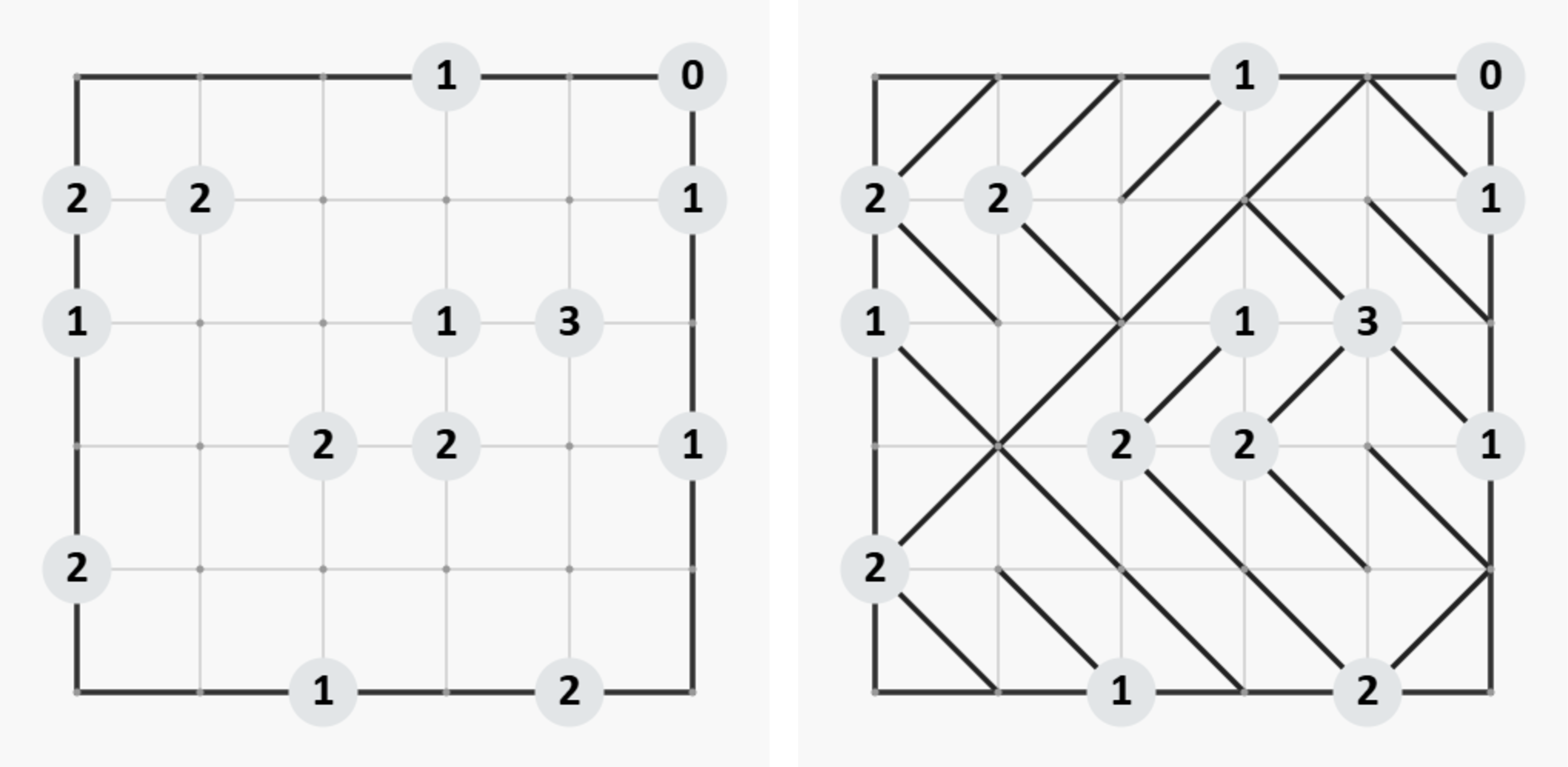
Goal: Draw a diagonal line in every cell to create a valid network without any closed loops. Rules: - Every square cell must contain exactly one diagonal line, slanting either left-to-right (/) or right-to-left (\). - Numbers at grid intersections indicate how many diagonal lines must connect to that specific point (0, 1, 2, 3, or 4). - Intersections without numbers can have any number of connecting lines. - The diagonal lines must never form a closed loop or circuit anywhere on the board. - Use logic and intersection counts to discover the unique solution.
- Logic
- Grid
- Lines
- Deduction